

EPA To Track Tremors -Nuclear-test watchdog to equip national facility
MONROVIA – When the ground shook in Lofa, Liberia had only rumor. It could not say whether the tremor was nature or dynamite. That gap now has a plan behind it. Liberia and a UN nuclear-test watchdog have now agreed to build a national monitoring data centre. The Environmental Protection Agency will host and run the facility. Sensors that hunt secret nuclear blasts also read earthquakes and tsunamis. For Liberians, that means facts after a tremor, not guesswork. The centre also promises safer mining and quicker disaster response. The harder part is securing equipment, training and steady funding. The deal turns a frightening 2024 unknown into a practical investment in public safety, as THE ANALYST reports.
Liberia is moving forward with plans to establish a National Data Centre that will help the country detect and understand earth tremors and other unusual events. The centre will be hosted and coordinated by the Environmental Protection Agency (EPA) of Liberia.
A Gap Exposed
The need for the centre became clear in 2024, when residents of Lofa County reported two earth tremors. An EPA team travelled to the affected areas to investigate. The incidents showed that Liberia did not have the equipment and systems needed to properly record the shaking, determine what caused it or provide the public with timely information.
The EPA therefore recommended that a national monitoring system be established.
Following the investigations, EPA Executive Director Dr. Emmanuel K. Urey Yarkpawolo travelled to Vienna for the 68th General Conference of the International Atomic Energy Agency (IAEA) in September 2024.
On the recommendation of Liberia’s Ambassador to Germany and the IAEA, Youngor Sevelee Telewodah, he began discussions with the Comprehensive Nuclear-Test-Ban Treaty Organization (CTBTO) about helping Liberia establish the centre.
The CTBTO manages a worldwide system that listens for vibrations in the ground, unusual sounds in the atmosphere and oceans, and radioactive materials in the air. Its main purpose is to detect nuclear test explosions.
The same information can also help countries understand earthquakes, earth tremors, mining explosions, tsunamis and other hazards.
From Vienna To Monrovia
Liberia continued the discussions during the 69th IAEA General Conference in September 2025. Urey Yarkpawolo was joined by Agriculture Minister Dr. J. Alexander Nuetah and Ambassador Telewodah.
The EPA also named a national contact person through the Ministry of Foreign Affairs to coordinate communication with the CTBTO.
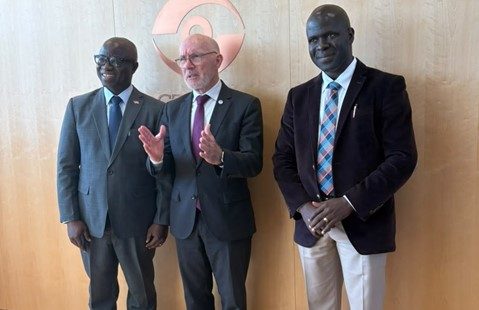
On September 14, 2026, Liberia and the CTBTO held a high-level meeting to conclude the discussions and begin the practical work. The Liberian delegation included Nuetah; Urey Yarkpawolo; Deputy Foreign Minister for International Cooperation and Economic Integration Dr. Ibrahim Nyei; officials of the Ministry of Health; Ambassador Telewodah; and other government officials.
The EPA has already commissioned a modern environmental laboratory in Monrovia that can host the National Data Centre. The CTBTO will work with Liberia on the equipment, computer systems and training needed to make the centre operational.
What It Means
The centre will give trained Liberian experts access to information collected by the CTBTO’s worldwide monitoring network. When the ground shakes in Liberia, experts will be better able to determine where the event happened, how strong it was and whether it was a natural tremor or an explosion linked to mining or quarrying.
This will directly benefit ordinary Liberians. Communities can receive clearer information after a tremor instead of depending on rumors. Government institutions will be better prepared to assess possible dangers and respond to emergencies.
The information can also guide the construction of roads, bridges, schools and other public facilities in areas that may face geological risks.
The centre will support safer mining by helping authorities separate natural ground movement from explosions caused by mining and quarrying. It can also strengthen preparations for earthquakes and possible tsunami threats, with useful information shared with the National Disaster Management Agency (NDMA) and other responsible institutions.
There will also be benefits for the environment, agriculture and health. Information on the atmosphere, oceans and radioactive materials can help Liberia protect its air, water, soil, farms, food and coastal communities. It can also help authorities respond if radioactive pollution from an incident elsewhere reaches the region.
Training Liberians
Liberian scientists, university students, geologists, health workers and disaster-management professionals will receive specialized training. This will build local knowledge and reduce Liberia’s dependence on foreign experts whenever unusual environmental events occur.
The EPA will operate the centre as a national facility and work with the Ministries of Foreign Affairs, Agriculture, Health, and Mines and Energy; the Liberia Geological Survey; the NDMA; universities; and other relevant institutions. The arrangement is designed to make the centre a shared national resource rather than a single agency’s project.
The National Data Centre is therefore not only about nuclear-test monitoring. It is a practical investment in public safety, environmental protection, agriculture, responsible mining and scientific development. With the discussions completed, Liberia and the CTBTO can now move to technical assessment, installation of equipment, training of personnel and the opening of the centre.
Comments are closed.