

Ellen Ranks with Mandela – Shares Roster With Nkrumah, Nyerere
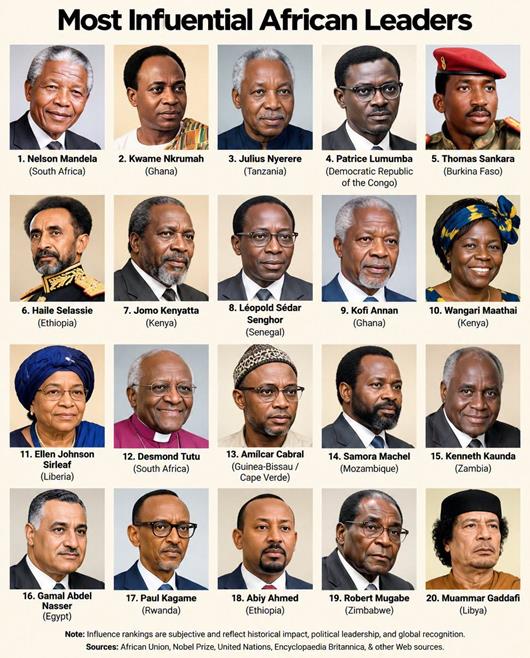
MONROVIA – Ellen Johnson Sirleaf marks her 88th birthday in the company of Mandela, Nkrumah and Nyerere. A global index, The Data of Everything, lists her among Africa’s 20 most influential leaders of all time. Eighteen of its 20 names are men. Only she and Kenya’s Wangari Maathai represent African women on it. That imbalance sharpens the significance of her inclusion. It also mirrors the patriarchal order she is credited with breaking in 2006. The citation rests on debt relief, peacebuilding and a peaceful handover of power. Lists like this are always contestable, and this one invites argument. Still, as THE ANALYST reports, her place on it confirms Liberia has produced a figure of continental stature.
As she marks her 88th birth anniversary today, Thursday, October 29, 2026, Liberia’s former President and Nobel Peace Laureate, Madam Ellen Johnson Sirleaf, has earned a historic place in the pantheon of global statesmanship after being listed among the 20 Most Influential African Leaders of all time.
The global ranking, compiled by the international research index The Data of Everything and drawing on authoritative archives from the African Union (AU), the United Nations (UN), the Nobel Prize and Encyclopaedia Britannica, places Sirleaf in the elite company of continental luminaries. Standing alongside foundational African giants such as South Africa’s anti-apartheid icon Nelson Mandela, Ghana’s Pan-Africanist pioneer Kwame Nkrumah, Tanzania’s philosopher-king Julius Nyerere, Burkina Faso’s revolutionary leader Thomas Sankara and former UN Secretary-General Kofi Annan, Sirleaf shines as one of the definitive female figures on the continental roster.
Breaking Barriers, Rebuilding Nations
The global citation recognizing Sirleaf underscores her monumental role in shattering centuries of patriarchal governance in Africa when she was inaugurated in 2006 as the continent’s first democratically elected female head of state. According to sources referenced from the Nobel Prize and Encyclopaedia Britannica, her inclusion among Africa’s top 20 leaders stems not only from her historic election, but from her extraordinary stewardship in leading Liberia out of the ashes of a 14-year civil war. Her presidential tenure was defined by major structural achievements, including securing over US$4.6 billion (about L$838.86 billion) in international debt cancellation, rebuilding shattered state institutions, maintaining national peace and enforcing public fiscal integrity.
Her legacy was further elevated in 2011 when she was co-awarded the Nobel Peace Prize for her non-violent struggle for the safety of women and their right to full participation in peacebuilding. Her landmark decision to step down at the end of her constitutionally mandated tenure in 2018, facilitating Liberia’s first peaceful, democratic transfer of executive power in over 70 years, anchored her standing as a guardian of constitutional democracy in Africa.
Blueprint for African Women, Youth
The international compilation highlights how Sirleaf’s post-presidential work through the Ellen Johnson Sirleaf Presidential Center for Women and Development (EJS Center) continues to influence global governance. Through initiatives such as the Amujae Initiative, she has converted her personal achievements into a sustainable pipeline, mentoring and equipping emerging female leaders to take up top-tier public roles across Africa.
As well-wishers, international diplomats and ordinary Liberians gather at her Monrovia residence today to mark her 88th birth anniversary, this international recognition provides a fitting backdrop to celebrate “Ma Ellen.” Her inclusion on a list featuring the likes of Wangari Maathai, Patrice Lumumba, Léopold Sédar Senghor and Samora Machel reinforces a compelling truth: Ellen Johnson Sirleaf is not merely a former President of Liberia, but a continental treasure whose vision, courage and dedication to peace will continue to shape African and global history for generations to come.
Africa’s 20 Most Influential Leaders
The list of the 20 Most Influential African Leaders in History features Nelson Mandela (South Africa), Kwame Nkrumah (Ghana), Julius Nyerere (Tanzania), Patrice Lumumba (Democratic Republic of the Congo), Thomas Sankara (Burkina Faso), Haile Selassie (Ethiopia), Jomo Kenyatta (Kenya), Léopold Sédar Senghor (Senegal), Kofi Annan (Ghana) and Wangari Maathai (Kenya). It also includes Ellen Johnson Sirleaf (Liberia), Desmond Tutu (South Africa), Amílcar Cabral (Guinea-Bissau/Cape Verde), Samora Machel (Mozambique), Kenneth Kaunda (Zambia), Gamal Abdel Nasser (Egypt), Paul Kagame (Rwanda), Abiy Ahmed (Ethiopia), Robert Mugabe (Zimbabwe) and Muammar Gaddafi (Libya).
Comments are closed.