

Conteh Welcomes Liberian Delegation -Liberia, MCC Advance New Compact Talks
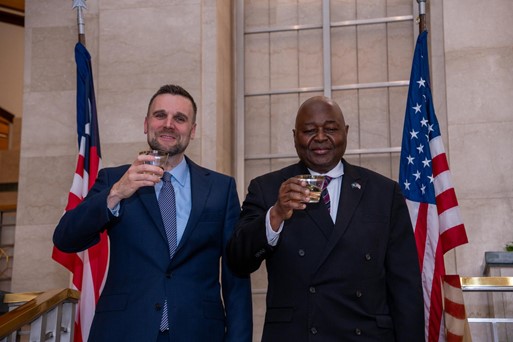
MONROVIA – Liberia is preparing a fresh bid for American development money. A technical team led by Alieu Fuad Nyei is in Washington for talks with the Millennium Challenge Corporation (MCC). Ambassador Al-Hassan Conteh used an MCC reception to frame the stakes. Electricity, he argued, is the binding constraint on Liberia’s growth. Without reliable and affordable power, factories, farms, and public services cannot expand. He listed five further priorities, from roads to practical skills for women and young people. Each, he insisted, must survive rigorous economic analysis. That is the MCC standard. Its compacts reward hard evidence over political wish lists. As THE ANALYST reports, pundits believe Liberia’s chances now rest on the quality of its numbers.
Liberia’s Ambassador to the United States of America, His Excellency Dr. Al-Hassan Conteh, has welcomed a high-level technical delegation from Liberia to Washington, D.C., for consultations with the United States Millennium Challenge Corporation (MCC) aimed at advancing the analytical and strategic framework for the development of Liberia’s proposed new MCC compact.
Conteh made the remarks on Tuesday, November 10, 2026, during a reception hosted by MCC in honor of the visiting Government of Liberia delegation.
The reception brought together senior MCC officials, heads of the private sector, members of the Liberian Embassy’s diplomatic staff, representatives of the Liberian diaspora, and other distinguished guests.
The gathering provided an opportunity to recognize the growing cooperation between Liberia and the United States in advancing development priorities designed to stimulate economic growth, strengthen institutional capacity, attract private investment, and improve the livelihoods of the Liberian people.
The Liberian delegation is headed by Mr. Alieu Fuad Nyei, National Coordinator of Liberia’s Compact Development Team (CDT), and comprises a multidisciplinary group of economists, financial and investment specialists, energy professionals, environmental and social development experts, and senior technical officials from relevant government institutions.
Other members of the delegation include Mr. Thomas B. Kanneh, Senior Economist; Mr. Molley O. Kiazolu, Director of Finance, Investment and Trade; Mr. Kemoh Lumei, Director of Energy; Mr. B. Garmondyu Zogar, Environmental and Social Performance Specialist; Ms. Tennen B. D. Tehoungue, Social Analysis Specialist; and Ms. Antoinette Y. Sendolo, Stakeholder Engagement and Communication Specialist.
The delegation also includes Mr. Dele I. Shobayo, Senior Director at the Liberia Electricity Corporation (LEC), providing technical support on the energy project, and Mr. Samuel Summerville, Assistant Minister at the Ministry of Mines and Energy, providing technical support on the mining project.
The delegation’s technical engagements with MCC are intended to contribute to the preparation of an evidence-based development framework that will inform the identification, prioritization, and eventual design of potential investments under Liberia’s proposed compact.
MCC, Diaspora Reaffirm Support
Speaking separately at the reception, Mr. Jason Small, Vice President for Compact Development at MCC, and Mr. Sebastian Teclar, President of the Liberian Community Association of the DMV, conveyed greetings on behalf of their respective institutions and highlighted the significance of the emerging development partnership.
Small’s remarks emphasized MCC’s commitment to a rigorous, collaborative, and country-led approach to compact development, including the importance of sound economic analysis, institutional coordination, and sustainable development outcomes.
Representing the Liberian diaspora, Teclar underscored the community’s interest in development initiatives that expand economic opportunities, improve essential infrastructure, and create lasting benefits for Liberians at home and abroad.
The participation of diaspora representatives also reflected the importance of maintaining strong connections between Liberia’s development institutions and Liberian communities in the United States.
Conteh Seeks Evidence-Based Investments
Delivering his goodwill message, Conteh expressed satisfaction with the collaborative approach adopted by MCC and Liberia’s Compact Development Team in preparing the foundational analytical and strategic document for the proposed compact.
He described the process as an important opportunity for Liberian and American technical experts to jointly identify the country’s most pressing economic constraints and develop practical, measurable, and sustainable responses.
The Ambassador emphasized that the compact-development process should extend beyond the preparation of technical documents to become a strategic instrument for accelerating Liberia’s long-term economic transformation.
He observed that the success of the proposed compact would depend on the quality of the underlying economic analysis, the careful selection of investment priorities, effective institutional coordination, and the capacity to deliver measurable benefits to the Liberian people.
Conteh further stressed the importance of aligning the proposed investments with Liberia’s national development priorities while ensuring that projects are economically justified, technically feasible, environmentally sustainable, and capable of attracting complementary private-sector investment.
Electricity as Critical Priority
A central theme of Conteh’s remarks was the urgent need to address Liberia’s electricity constraints. He identified reliable, affordable, and accessible electricity as a fundamental binding constraint to Liberia’s economic growth, emphasizing that energy infrastructure must occupy a prominent position in the country’s development strategy.
According to the Ambassador, adequate electricity supply is indispensable for industrial development, agricultural modernization, manufacturing, technological innovation, improved public services, and the expansion of employment opportunities.
He noted that high electricity costs, inadequate generation capacity, and limited access to reliable power continue to constrain business competitiveness, discourage productive investment, and increase the cost of economic activity.
Conteh therefore encouraged the technical teams to give particular attention to investments capable of strengthening electricity generation, transmission, distribution, and the financial and operational sustainability of the energy sector. He also highlighted the importance of exploring opportunities for private-sector participation, renewable energy development, and investments that could help expand reliable electricity access to productive enterprises and underserved communities.
Five Additional Compact Priorities
Beyond electricity, Conteh identified five complementary areas that deserve careful consideration during the compact-development process. First, on transport infrastructure and trade connectivity, the Ambassador emphasized the importance of improving roads, transport corridors, and logistics systems to reduce transaction costs, facilitate agricultural commercialization, strengthen regional trade, and improve Liberia’s competitiveness.
Second, on institutional governance and regulatory reforms, he called for strengthening public institutions, improving transparency and accountability, and developing predictable regulatory frameworks capable of promoting investor confidence and ensuring the effective implementation of major development projects.
Third, on private-sector development and employment creation, Conteh emphasized that public development investments should help unlock private capital, support small and medium-sized enterprises, strengthen domestic value chains, and expand productive employment opportunities.
Fourth, on human capital development, he underscored the importance of technical and vocational education, workforce development, and the acquisition of practical skills needed to support modern industries. Particular attention, he noted, should be given to opportunities for women and young people.
Fifth, on environmental sustainability and social inclusion, the Ambassador called for the integration of climate resilience, environmental safeguards, stakeholder consultation, and equitable community participation into the design and implementation of development investments. He emphasized that these priorities should be subjected to rigorous economic analysis to determine their relative importance, feasibility, and potential contribution to sustained poverty reduction and economic growth.
Embassy Reaffirms MCC Partnership
Conteh also reflected on the Embassy’s continuing engagement with MCC and other United States development and investment institutions as part of Liberia’s broader economic diplomacy agenda. He noted that the Embassy has consistently promoted stronger cooperation with American institutions and businesses to support Liberia’s infrastructure development, energy security, investment promotion, and economic diversification.
The Ambassador referenced the Invest in Liberia Roadshow, held on October 5, 2026, in Washington, D.C., as one of the initiatives undertaken by the Office of the Special Envoy of the Ministry of Foreign Affairs, Mr. Isaac Taggart, and attended by Foreign Minister Madame Sara Beysolow Nyanti, to strengthen Liberia’s visibility among prospective American investors and development partners. He further expressed appreciation to Ms. Carrie Monahan, MCC Country Director for Liberia, for her continued engagement with the Embassy and for representing the United States Government at the Embassy’s celebration of Liberia’s 179th Independence Anniversary on July 25, 2026, in Washington, D.C.
Conteh described such engagements as important demonstrations of the enduring friendship between Liberia and the United States and the shared commitment of both countries to sustainable development and mutually beneficial economic cooperation. He reaffirmed the Embassy’s readiness to facilitate communication, strengthen institutional partnerships, and support the Liberian delegation throughout its consultations in Washington.
Appreciation to Reception Organizers
The Ambassador extended sincere appreciation to the leadership and staff of MCC for hosting the reception and for their continuing partnership with Liberia. He particularly acknowledged Minister Counselor Yaba Thompson of the Embassy of Liberia and Ms. Molly Johnson, MCC Senior Program Officer, for their contributions to planning and coordinating the reception.
He also commended members of the Embassy staff, representatives of the Liberian diaspora, and other participants whose presence contributed to the success of the gathering. In concluding his remarks, Conteh wished Nyei and members of the Liberian delegation a fruitful and productive visit to Washington, expressing optimism that their technical consultations would help establish a strong analytical foundation for Liberia’s proposed compact.
The Embassy emphasized that the ongoing compact-development process represents an important opportunity to deepen United States–Liberia economic cooperation and advance investments capable of generating sustainable growth, strengthening national institutions, and improving the economic well-being of the Liberian people. The Embassy of Liberia in Washington, D.C., remains committed to supporting initiatives that translate the longstanding friendship between Liberia and the United States into concrete, measurable, and lasting development outcomes.
Comments are closed.