

AML Nears $4 Billion -ArcelorMittal Says Operations Support 8,000 Jobs
MONROVIA – ArcelorMittal Liberia is making its case to Liberians with numbers. The company says its investment is approaching $4 billion since mining resumed in 2011. It claims some 8,000 direct and indirect jobs and a record 10 million tons shipped in 2025. Its new concentrator promises higher-grade exports and a step up the value chain. The amended Mineral Development Agreement will open the railway to other miners. Yet the figures are largely the company’s own. The real test lies in Nimba, Bong and Grand Bassa counties. There, communities still ask whether ore wealth reaches their tables. Van der Merwe pledges 40 more years. Liberians will judge by jobs, revenue and roads, THE ANALYST reports.
The investment of ArcelorMittal Liberia (AML) in the country is increasingly extending beyond iron ore production. It is supporting thousands of jobs, expanding national infrastructure, generating government revenue and creating business opportunities across several sectors of the economy.
With cumulative investment approaching $4 billion (L$729.44 billion), the company’s operations have become an important part of Liberia’s economic development since large-scale mining resumed in 2011.
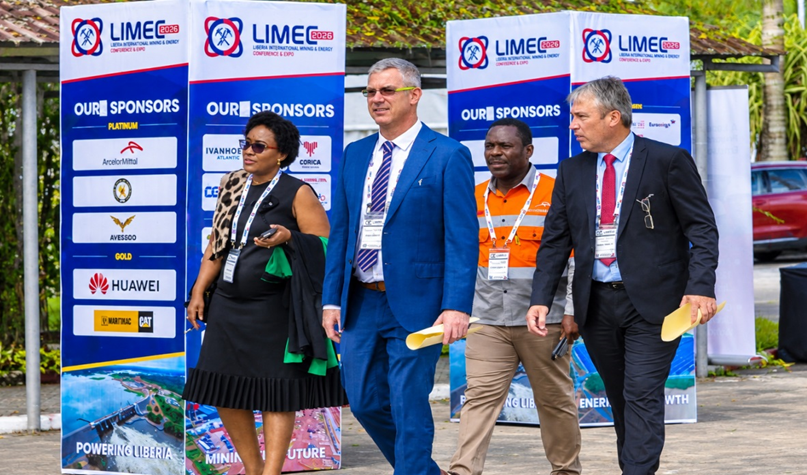
Speaking last week at the Liberia International Mining and Energy Conference (LIMEC), AML Chief Executive Officer Michiel van der Merwe said the investment covered mining, railway, port, power and social infrastructure.
He described it as an investment in “jobs, skills and local businesses,” adding that the company had maintained its operations through three successive presidential administrations.
Thousands of Jobs, Local Opportunities
Employment remains one of the most direct benefits of the investment. AML estimated in January 2026 that its operations supported approximately 8,000 direct and indirect jobs. Company figures from May 2025 showed that Liberians accounted for 90 percent of its permanent workforce.
Additionally, 5,508 Liberians were recruited by contractors between January and December 2025, providing employment across skilled and unskilled categories.
Beyond direct employment, the mining operation generates demand for transportation, construction, engineering, catering, accommodation, equipment maintenance and other services.
These activities create opportunities for Liberian businesses, stimulate local markets and provide income for households in communities surrounding the company’s operations.
Phase II and Record Exports
The ongoing Phase II expansion is expected to deepen these economic benefits. Central to the project is Liberia’s first large-scale iron ore concentrator, which enables the production of higher-grade iron ore concentrate for international markets.
The development represents an important step toward moving Liberia further up the mineral value chain rather than relying predominantly on exports of direct-shipping ore.
The expansion is already reflected in rising exports. AML shipped approximately four million metric tons of iron ore in 2024 and achieved a record 10 million metric tons in 2025. At LIMEC, van der Merwe said the company expected exports to exceed 20 million metric tons in 2027.
Increased shipments could strengthen foreign exchange earnings and government revenue through applicable taxes, royalties and other payments.
Railway Becomes Multi-User Corridor
Another major national benefit is the rehabilitation and expansion of the 245-kilometer railway connecting the company’s mines in Nimba County to Buchanan Port.
Although the railway and port facilities belong to the Government of Liberia, AML says it has invested approximately $800 million (L$145.89 billion) in rehabilitating and expanding their capacity. The infrastructure is increasingly important not only to the company but also to Liberia’s ambition to attract additional mining investors.
Under the Third Amendment to the Mineral Development Agreement (MDA), ratified in January 2026, the railway is intended to become a multi-user corridor, allowing other mining companies to seek access under arrangements determined by the government. An independent railway operator is expected to assume responsibility for the corridor in 2030.
Van der Merwe said the company supported the arrangement, noting that prospective users would only need to finance additional expansion required for their operations. If effectively implemented, this could lower infrastructure barriers for new investors and open opportunities for further mining development.
The amended agreement also provides for a $200 million (L$36.47 billion) payment associated with the extension of mining rights and reserved railway capacity, while increasing AML’s annual contribution to the Community Development Fund from $3 million (L$547.08 million) to $5 million (L$911.80 million).
The fund is intended to support development initiatives in Nimba, Bong and Grand Bassa counties, providing resources for communities affected by mining operations.
Beyond the Concession Areas
Beyond these financial commitments, AML’s social investments have supported healthcare, education, scholarships, housing and community infrastructure in its operational areas. These interventions complement employment and government revenue by helping address development needs in communities hosting the company’s operations. Their lasting impact will depend on transparent management, effective implementation and meaningful community participation.
The broader economic opportunity lies in ensuring that mining investment stimulates growth beyond the concession areas. Increased production and infrastructure capacity can support local suppliers, create demand for technical services, strengthen transportation networks and improve Liberia’s attractiveness to international investors.
Realizing these benefits will require sustained investment in vocational training, local enterprise development and the skills needed to fill increasingly specialized positions in the mining industry.
Van der Merwe said Liberia’s development depended on cooperation among government, investors, industry and communities. “No single company, government institution or investor can achieve all of Liberia’s goals alone,” he told delegates, reaffirming AML’s intention to remain in the country for decades.
“We’ve played this part for the last twenty years and we are ready to do so for another forty years or more.” For Liberia, the ultimate measure of the partnership will be how effectively these investments translate into more jobs, stronger public revenue, competitive local businesses, improved infrastructure and better living conditions for its people.
Comments are closed.