
Tweah Mounts Robust Defense -As Court Orders CBL Governor to Verify Key Evidence
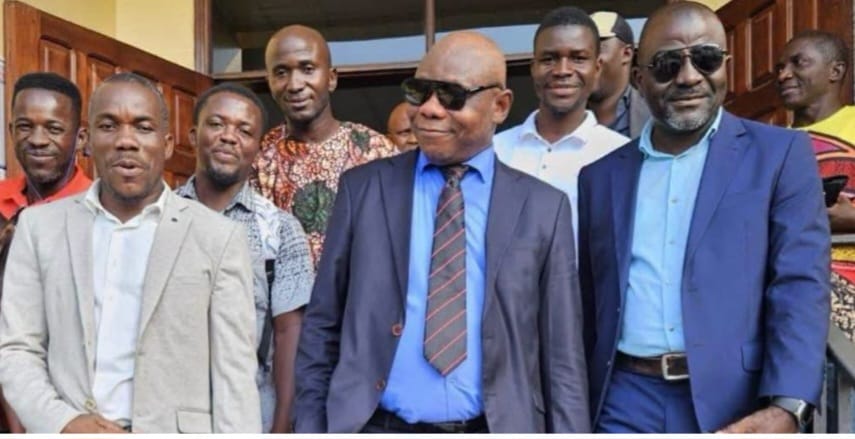
MONROVIA – Former Finance Minister Samuel D. Tweah Jr. delivered a sweeping and technically grounded defense in court on Monday, challenging the very foundation of the prosecution’s case against him, as the presiding judge ordered the head of the Central Bank of Liberia to appear and authenticate crucial defense documents.
The dramatic courtroom development came after Tweah, under direct examination by his lead counsel Arthur Johnson, laid out what he described as a structured dismantling of the indictment, methodically confronting key allegations with legal interpretation, policy context, and examples from prior government transactions.
A Calculated Legal Counteroffensive
Taking the stand with confidence, Tweah organized his testimony around six central observations drawn from the indictment, focusing the day’s proceedings on four critical claims: that no spending request originated from national security actors, that he lacked the authority to act, that the financial transactions in question were illegal, and that he conspired with former Acting Justice Minister Nyanti Tuan.
Blending his experience in public finance with his role as a former member of Liberia’s National Security Council, Tweah offered the court a detailed interpretation of government spending authority under the country’s Public Financial Management (PFM) framework. His testimony sought to reframe the prosecution’s narrative as one built on a misunderstanding of how fiscal decisions are lawfully triggered and executed.
Challenging the Prosecution’s Core Assumptions
Central to Tweah’s defense was a direct rebuttal of the Prosecution’s claim that the absence of formal documentation rendered the transactions unlawful.
He argued that for budgeted expenditures, the legal trigger is the passage of the national budget itself, not the existence of a payment request. In cases involving emergency or non-budgeted spending, he maintained, the trigger shifts to executive consensus in response to urgent national needs, where formal requests may not always be generated.
This interpretation, if upheld, could significantly undercut the Prosecution’s reliance on what it has characterized as missing documentation.
Direct Transfers Framed as Established Practice
In one of the hearing’s most pivotal moments, Tweah introduced examples of past government transactions processed through the Central Bank, asserting that the mechanisms now under scrutiny have long been part of standard fiscal operations.
He cited multimillion-dollar transfers, including over US$15 million to the National Elections Commission, US$25 million to the World Food Programme for COVID-19 relief, and US$1 million to the United Nations Population Fund for the 2022 National Census.
According to the defense, these transactions were executed using the same procedures currently being labeled as illegal, an argument aimed at demonstrating inconsistency in the Prosecution’s position.
Court Sides with Defense on Key Evidence
The courtroom tension escalated when the defense sought to subpoena the Central Bank Governor to authenticate documentary instructions tied to these prior transactions. Prosecutors objected, arguing that the documents were irrelevant to the charges at hand.
However, presiding Judge Judge Feika overruled the objection, granting the defense’s request and ordering the issuance of a subpoena.
The Governor, or a designated representative from the Central Bank, is now expected to testify and verify the authenticity of photocopied documents already submitted into evidence. The ruling marks a significant procedural victory for the defense.
Mounting Pressure on the Prosecution
Legal analysts observing the proceedings say the court’s decision could prove consequential. If authenticated, the documents may directly contradict earlier testimony suggesting that such direct transfers had never occurred, thereby strengthening the defense’s argument that the transactions were both lawful and consistent with established government practice.
The development also raises broader questions about the strength of the prosecution’s case, particularly its interpretation of financial procedures within Liberia’s public sector.
The trial is set to resume Tuesday at 10:00 AM, with Tweah expected to continue his testimony as both sides prepare for what is shaping up to be a pivotal phase in the proceedings.
As the courtroom battle intensifies, the case is increasingly being viewed as a critical test of how Liberia’s legal system interprets the intersection of public finance management and national security decision-making.
Comments are closed.