

Measuring ARREST At Midterm Moment-Agriculture, Roads, Power Define Progress
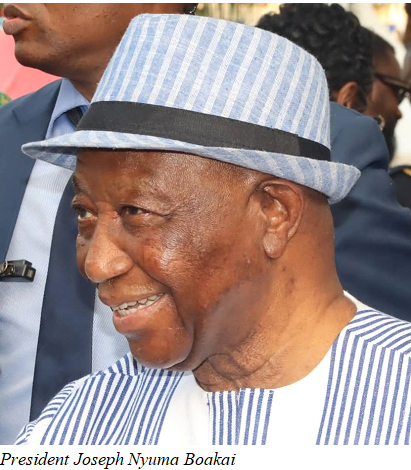
MONROVIA – When President Joseph Nyuma Boakai stood before the Fifty-Fifth Legislature on January 26, 2026, to deliver his third State of the Nation Address (SONA), he did so at a defining moment in his presidency. Nearly halfway into his six-year term, the President was no longer speaking primarily from the posture of inherited crisis, transition, or goodwill. Instead, he faced a more exacting public standard: evidence of delivery. In an address lasting one hour and twenty-five minutes, President Boakai outlined what he described as tangible progress under his ARREST Agenda for Inclusive Development. Central to his message were three interlinked sectors—agriculture, roads, and energy—pillars he portrayed as foundational to jobs, food security, national integration, and economic resilience. The Analyst reports.
President Joseph Nyuma Boakai’s third State of the Nation Address (SONA) was framed as a report card on action rather than intention. Delivered under heightened public scrutiny, the address sought to demonstrate that the ARREST Agenda—Agriculture, Rule of Law, Roads, Education, Sanitation, and Tourism—is moving from policy design toward measurable outcomes.
While the address touched on governance, social services, and international relations, the President placed particular emphasis on agriculture, infrastructure, and energy. These sectors, long identified as structural constraints on Liberia’s development, were presented as areas where progress is visible and momentum building. The Analyst examines those claims, assesses their significance, and outlines the challenges that will determine whether progress can be sustained.
Agriculture: From Food Insecurity to Market Orientation
Agriculture occupied a central place in President Boakai’s address, described as the “heart” of the ARREST Agenda and the most immediate pathway to inclusive growth. The President reported that in 2025 alone, more than 198,000 farmers received government support, contributing to expanded rice and cocoa cultivation and increased aquaculture output.
“In 2025, over 198,000 farmers received government support, leading to expanded rice and cocoa cultivation and increased aquaculture output,” President Boakai told lawmakers. “Infrastructure improvements, including the completion of 166 kilometers of feeder roads, reduced transport costs and enhanced market access, resulting in 33,755 Liberians moving from food insecurity to food security.”
The emphasis on feeder roads reflects an understanding that agricultural productivity cannot be separated from access. Poor rural connectivity has historically undermined farmers’ ability to transport produce to markets, often resulting in post-harvest losses and depressed farm-gate prices. The administration argues that targeted infrastructure investments are beginning to close this gap.
Beyond inputs and access, the President outlined a strategic pivot from subsistence farming to agribusiness and commercialization. Planned initiatives for 2026 include scaling domestic rice production, expanding mechanization services, operationalizing the One County–One Priority Commodity program, and unlocking agricultural finance through new banking legislation.
Symbolically, the launch of Liberia’s first fiberglass semi-industrial fishing vessel, the SEA KING, was highlighted as part of efforts to boost domestic fish production and reduce reliance on imports. Fisheries, often overlooked in agricultural policy, represent a critical protein source and employment opportunity along Liberia’s coastline.
However, analysts caution that scale alone does not guarantee transformation. Long-term impact will depend on productivity gains per hectare, post-harvest storage and processing, access to affordable credit, and the development of agro-processing value chains. Without these, increased output risks flooding markets, driving prices down, and limiting income gains for smallholders.
Infrastructure: Roads as Instruments of Economic Integration
Road infrastructure formed the most detailed and data-heavy portion of President Boakai’s address. Recalling his campaign pledge to prioritize roads as tools of national integration, the President reported that Liberia’s paved road network has increased from under 12 percent to at least 20 percent, alongside the maintenance of more than 780 kilometers of major routes.
Connectivity improvements were cited across multiple corridors, including Brewerville–Bopolu, Salayea–Mendikorma, Tappita–Zwedru, and Buchanan–Greenville. Several strategic roads were reported at advanced completion stages: Ganta–Saclepea at 56 percent, Saclepea–Tappita at 92 percent, and Sanniquellie–Logatuo at 86 percent. The Kelipo–Fish Town road, a critical southeastern corridor, is now fully paved.
“We increased Liberia’s paved roads from under 12 percent to at least 20 percent, and maintained more than 780 kilometers of major routes, ensuring year-round access,” President Boakai said. “Connectivity improved across key corridors, reducing costs and easing hardship for our people.”
The President also addressed public debate surrounding the procurement of 285 pieces of heavy construction equipment—popularly referred to as “Yellow Machines.” He confirmed that the equipment is currently being shipped and will be deployed to county hubs to support road maintenance, emergency response, and disaster mitigation.
Further momentum is expected from the Pavifort Concession Agreement, a public-private partnership covering strategic routes such as St. Paul Bridge–Bo Waterside, Medina–Robertsport, and Mendikorma–Voinjama. Construction is scheduled to begin next month following legislative approval.
Urban infrastructure has also received attention. Alleyways, drainage systems, street lighting, and planned overpasses along Tubman Boulevard are underway, with completion targeted for 2027. Since the start of the administration, the government reports paving 411 kilometers of rural roads and 122 kilometers of urban roads. By 2029, the goal is to exceed 485 kilometers of paved roads nationwide.
Yet challenges remain. Delays linked to audits, procurement reviews, and scope adjustments—particularly along the RIA Road Corridor—highlight ongoing issues in project management and coordination. Ultimately, the economic return on road investments will be measured not in kilometers paved, but in reduced transport costs, expanded trade flows, and increased private investment beyond Monrovia.
Energy: Stabilization, Expansion, and Industrial Ambition
Energy was presented as the critical enabler of economic transformation. President Boakai reported that in 2025, the Liberia Electricity Corporation (LEC) achieved 63,000 new electricity connections, extending power to 124 villages and providing 17,000 households with first-time access.
Electricity tariffs were reduced to ease household costs, while rural electrification—largely solar-based—powered 88 clinics across 14 counties and installed 3,791 streetlights in more than 124 towns and villages. Universities, hospitals, and cross-border grid infrastructure benefited under the CLSG Rural Electrification Program.
Operational improvements at the Mount Coffee Hydropower Plant were also highlighted. According to the President, power outages declined, electricity sales increased by 24 percent, revenue exceeded US$71 million, and collection efficiency reached 94 percent—figures suggesting improved institutional performance.
Looking ahead, the administration plans to add 100,000 new electricity connections in 2026, deploy smart meters, and reduce system losses to 35 percent. More ambitious still are plans for a 250MW gas-to-power plant, a 200MW solar plant with storage, and a new hydropower project on the St. John River. Combined with existing assets, total generation capacity is projected to exceed 700MW.
“In 2026, we plan to have 100,000 new connections and reduce system losses to 35 percent,” President Boakai said. “Major projects underway include gas, solar, and hydropower investments that will drive industrial growth.”
Energy experts note that while the vision is expansive, it is also capital-intensive. Success will depend on credible financing, regulatory stability, governance reforms at LEC, and the growth of industrial and commercial demand. Without parallel expansion in manufacturing and services, excess generation capacity could become a fiscal burden rather than a growth engine.
From Resolve to Results?
President Boakai’s third SONA reflects an administration intent on demonstrating movement from planning to execution. Reported gains in agriculture, road construction, and electricity access suggest measurable progress in sectors long constrained by underinvestment.
At the same time, the address raises familiar questions: Can momentum be sustained? Will projects translate into jobs and incomes at scale? And can institutions deliver consistently amid fiscal constraints and political pressure?
As Liberia moves deeper into Boakai’s first term, the ARREST Agenda faces its most consequential test—not in speeches delivered, but in outcomes felt by farmers, traders, households, and businesses nationwide. Subsequent installments of this series will examine the remaining pillars of the Agenda and assess whether the administration’s reform narrative aligns with lived reality.
Comments are closed.