

WAEC Promises Leakage-Free Results -Pledges Release Before August 14 Deadline
MONROVIA – The West African Examinations Council’s assurance on the 2026 results does more than set a date. It also confronts a swirl of online misinformation. Its insistence that no leakage occurred stakes the council’s credibility on the integrity of the entire exercise. This year’s examination also marked a quiet but notable milestone. It opened practical vocational subjects to Liberian candidates for the first time. A locally built digital attendance system signaled growing technical confidence, even as some workers resisted the change. Government payment of public-school examination fees eased a heavy financial burden on many families. Together, the disclosures frame an examination cycle balancing modernization, security and public trust in fragile conditions. THE ANALYST reports.
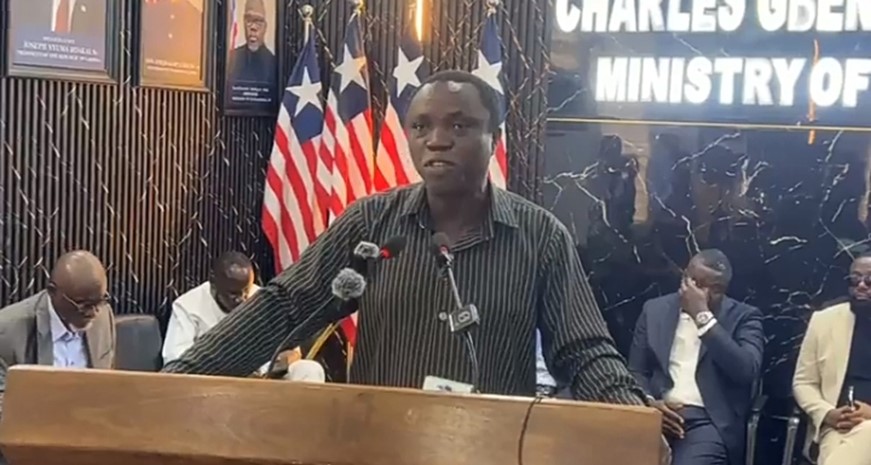
The Head of the Liberia National Office of the West African Examinations Council (WAEC), Dale Gbotoe, has assured the public that the results of the 2026 West African Senior School Certificate Examination (WASSCE) will be released on or before August 14, 2026. He dismissed reports circulating on social media that the results had already been released.
Speaking Tuesday at the Ministry of Information’s regular press briefing in Monrovia, Gbotoe described the social media reports as “fake” and intended to undermine the integrity of the examination process. “We want to assure the Liberian people that the results will be ready before August 14. Any information circulating on social media claiming that WAEC has already released the results is false and should be disregarded,” he emphasized.
Providing an overview of the just-ended national examination, Gbotoe disclosed that the 2026 WASSCE was administered from April 27 to June 19, with 1,126 senior high schools participating. Of that number, two schools from the Republic of Guinea also sat the examination under the Liberian curriculum, a collaboration that has existed since 2023.
He revealed that 57,739 candidates registered and sat the examination across 401 centers, including one located in Guinea. According to him, 138 centers were located outside Montserrado County, while 263 were within Montserrado, reflecting the county’s large student population.
Government Praised For Fees
The WAEC boss praised the Government of Liberia for paying the examination fees of all public-school candidates, describing the move as a significant investment in education. He said the gesture brought relief to thousands of parents and students.
For the first time in Liberia’s examination history, candidates pursuing Technical and Vocational Education and Training (TVET) programs were allowed to sit practical WASSCE subjects. These included animal husbandry, auto mechanics, basic electricity, blocklaying and bricklaying, carpentry and joinery, crop husbandry, metal work, plumbing and pipe fitting, tailoring, wood technology, and welding and fabrication.
Gbotoe said he was impressed by the practical skills demonstrated by students during the examinations, particularly in plumbing, blocklaying and other vocational disciplines. “The performances we witnessed clearly showed that these students possess practical skills that can contribute meaningfully to national development,” he noted.
Exams Held Without Leakage
He further announced that the examination was conducted without any leakage of question papers, describing the exercise as one of the most secure in recent years. According to him, more than 1,400 school supervisors, 1,135 invigilators and 353 distribution depots were deployed nationwide to ensure the smooth conduct of the examinations.
A major innovation introduced this year, he explained, was a digital attendance platform developed entirely by WAEC’s Liberian technical staff. The system enabled the council to monitor candidate attendance across examination centers in real time.
Gbotoe lauded the creativity of the Liberian professionals behind the innovation, saying it demonstrates that local experts can develop modern technological solutions. However, he admitted that the new platform experienced some challenges because a number of examination workers and school authorities were reluctant to use it.
“About 90 percent of the examination workers embraced the digital system, but some refused to use it, making it difficult to capture complete attendance records and affecting the timely processing of payments for some workers,” he explained. He said WAEC would continue refining the platform to improve adoption in future examinations.
Challenges And Malpractice Concerns
The WAEC Liberia boss also highlighted several operational challenges encountered during the examinations, including the delayed arrival of mathematical sets. As a temporary measure, candidates were permitted to use their own approved scientific calculators.
He raised concerns over what he described as “dark rooms” established by some schools, where individuals allegedly attempted to photograph examination questions and send answers back to candidates. He warned that WAEC remains committed to eliminating examination malpractice in all its forms.
Gbotoe commended the Liberia National Police for its cooperation throughout the examination period, particularly in responding to false information circulated on social media suggesting officers were interfering with candidates. According to him, investigations revealed that one widely circulated video had been deliberately manipulated to discredit both WAEC and the police.
He said the officer involved had in fact been enforcing examination regulations by preventing cheating. “We discovered that the information was misleading. The police officer was simply doing his duty by preventing examination malpractice,” he stated.
Marking Nearly Complete
On the status of the results, Gbotoe disclosed that all examination scripts have been successfully marked and that WAEC has completed approximately 90 percent of the post-processing exercise. He said teachers, examiners and checkers worked throughout the national holidays to ensure the marking was completed by the end of July, sacrificing time with their families to meet the council’s deadline.
He extended appreciation to the Ministry of Education, the Ministry of Information, examination supervisors, invigilators, teachers, checkers and partner institutions for their dedication throughout the examination period. Gbotoe explained that before the public release, the Ministry of Education and other statutory authorities would first receive official access in accordance with WAEC procedures.
He concluded by reaffirming WAEC’s commitment to transparency, credibility and professionalism. He assured students and parents that the council remains focused on protecting the integrity of the examination process while ensuring the timely publication of the 2026 WASSCE results.
Comments are closed.