

Test to Boakai’s Billion-Dollar Revenue Milestone MCSS Teachers, Students Protest
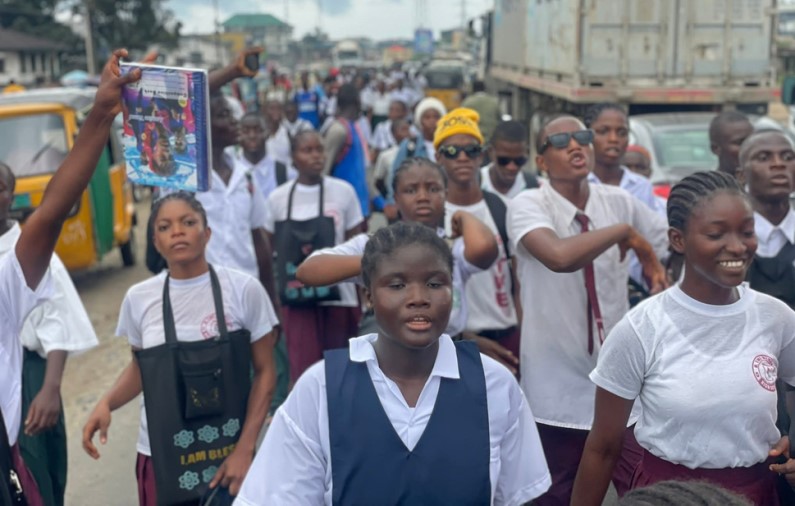
MONROVIA – Liberia has crossed US$1 billion in domestic revenue, yet a Bushrod Island high school says it has gone weeks without teachers. That contrast is the real story here. Students of D. Tweh Memorial High School marched on October 14, demanding that teachers return. Monrovia Consolidated School System teachers had already protested over pay and unmet resolutions. Finance Minister Augustine Kpehe Ngafuan insists the revenue is spent, not idle. The point is fair, but it moves the question to budget execution. How much reaches classrooms, and how fast? Free registration for kindergarten through Grade 6 widens access without guaranteeing instruction. Poorer families bear the heaviest cost of every lost school day. THE ANALYST reports.
The cries of schoolchildren demanding teachers in the streets of Monrovia have brought renewed attention to a difficult national question: what does Liberia’s growing revenue mean for ordinary citizens when some children cannot receive the basic education they report going to school to obtain?
On Wednesday, October 14, hundreds of students from D. Tweh Memorial High School on Bushrod Island reportedly took to the streets to protest the prolonged absence of teachers since the resumption of the new academic year.
Their demonstration came amid growing concerns over teachers’ welfare, deteriorating school infrastructure, rising living costs, and the practical implementation of the government’s free elementary school policy.
“No teachers for more than three weeks. Nobody to teach us. We are not learning anything. We want teachers,” some of the protesting students told journalists, expressing frustration over the disruption of their education. Their message was simple but troubling: students had returned to school expecting to learn, yet they said the teachers needed to deliver their lessons were not present.
The protest also followed a peaceful demonstration by aggrieved teachers under the Monrovia Consolidated School System (MCSS), who are demanding salary adjustments, improved welfare, and the implementation of resolutions they claim the government has repeatedly failed to address.
Taken together, the demonstrations reveal a growing tension between the government’s education commitments and the conditions some teachers and students say they are experiencing.
Beyond the immediate disruption at D. Tweh Memorial High School, the situation raises questions about the government’s capacity to translate public revenue into reliable education services, adequate working conditions for teachers, and a learning environment that gives Liberian children a fair opportunity to succeed.
The protests have emerged at a time when the Boakai administration is celebrating a historic milestone in domestic revenue generation.
Billion-Dollar Revenue Milestone
In September, President Joseph Nyuma Boakai announced that Liberia had surpassed US$1 billion (L$182.36 billion) in domestic revenue collections, describing the achievement as a significant development in the country’s ability to finance its own priorities.
According to the President, domestic revenue increased from approximately US$612 million in 2023 to US$699 million in 2024 and US$848 million in 2025 before surpassing the US$1 billion mark in 2026. The government has also projected revenue collection of US$1.3 billion by the end of December.
The achievement represents an important development in a country that has long faced constraints in mobilizing sufficient domestic resources to finance public services.
However, the announcement has also intensified public expectations. For many citizens, increased government revenue should eventually translate into better schools, functioning hospitals, improved roads, more reliable public services, and relief from the economic difficulties confronting households.
The latest school protests expose the distance that can exist between national revenue figures and the lived experiences of citizens. How can a country celebrate collecting more than US$1 billion while students report spending weeks without teachers? Why are educators demanding better pay and working conditions when the government says it has strengthened its revenue-generating capacity? And how should citizens measure economic progress when some public schools continue to struggle with staffing and infrastructure?
These questions do not automatically invalidate the government’s revenue achievement. Rather, they challenge the authorities to demonstrate how that achievement is being translated into measurable improvements in public services.
Revenue collection is an important measure of a government’s financial capacity. But the quality, accessibility, and reliability of public services are equally important measures of whether that capacity is benefiting the population.
Collecting Money, Delivering Services
The distinction between collecting money and delivering services is central to understanding Liberia’s current situation. The US$1 billion milestone represents cumulative domestic revenue collected during the year; it does not mean the government has US$1 billion sitting unused in a bank account. Public revenue finances a range of obligations, including public-sector salaries, infrastructure, healthcare, education, security, and other government operations.
Finance Minister Augustine Kpehe Ngafuan has explained that the revenue milestone should not be interpreted as money simply sitting idle, noting that the funds are continuously collected and spent in accordance with the government’s budget. Nevertheless, that explanation does not eliminate the need for accountability. It makes the questions surrounding budget execution, spending priorities, and the results of public expenditure even more important.
If revenue is increasing, citizens have a legitimate interest in knowing how much is allocated to education, how much is actually released to education institutions, and whether the resources reach the schools and teachers who need them.
A government may increase its revenue without immediately resolving every national problem. Competing demands, existing obligations, procurement processes, administrative weaknesses, and delays in releasing funds can all affect the delivery of services.
But where schools lack teachers or operate in deteriorating buildings, the government must be able to explain the specific obstacles preventing approved policies and allocated resources from producing the expected results.
The central question is therefore not simply whether Liberia has collected US$1 billion. It is whether public spending is addressing the country’s most urgent needs and whether citizens can see evidence of that spending in their daily lives.
Free Registration’s Limits
Another important dimension of the controversy is the government’s decision to eliminate registration fees for children attending public schools from kindergarten through Grade 6 beginning with the 2026/2027 academic year. The policy is intended to remove a financial barrier that prevents some parents from enrolling their children in school. It is supported through school financing arrangements associated with the Liberia EXCEL Project, school grants, and other education investment measures.
In August, the Ministry of Education announced that parents and guardians would no longer be required to pay registration fees for children in the covered grades at public schools.
The initiative is significant in a country where poverty and household financial pressures can prevent children from accessing education. However, eliminating registration fees addresses only one part of the education challenge.
A child may be admitted to school without paying a registration fee, but that child still needs a teacher, instructional materials, a safe classroom, functioning sanitation facilities, and sufficient time for learning.
Free registration cannot compensate for an absent teacher. Nor can it repair a deteriorating school building or guarantee that lessons will take place according to the academic calendar.
The distinction is important because access to education and the quality of education are closely connected but are not the same. The government’s policy may reduce the financial burden on parents, but its success must also be assessed by whether children are actually learning.
President Boakai’s administration has also backed the US$88.7 million Liberia EXCEL Project, designed to improve foundational learning in public early childhood and primary schools nationwide.
The project targets improvements in literacy and numeracy, teaching materials, teacher training, and school management. These commitments establish a framework for improving education.
The current protests, however, raise questions about the pace and consistency of implementation and the extent to which interventions are reaching schools experiencing immediate difficulties.
The fact that D. Tweh Memorial High School is a secondary institution also matters: the kindergarten-to-Grade-6 registration policy does not directly cover all of its students.
Nevertheless, the reported teacher shortage at the school highlights a wider education-sector concern that cannot be resolved through a primary-school registration policy alone.
Teachers at the Center
At the center of the crisis are teachers whose working conditions directly affect the delivery of education. The protesting MCSS teachers are demanding salary adjustments, improved welfare, and implementation of outstanding resolutions. Their grievances deserve examination because teachers are essential to any effort to improve learning outcomes.
A government may build classrooms, provide textbooks, remove registration fees, and introduce education reforms. But without teachers who are present, adequately supported, and prepared to teach, those investments cannot produce their full intended benefits. Teacher welfare is therefore not merely an employment issue. It is also an education-quality issue.
When educators protest over salaries and working conditions, students can become unintended casualties of a dispute between public employees and the institutions responsible for managing their employment. That is the dilemma confronting the students of D. Tweh Memorial High School. Their demand for teachers is understandable, even as the grievances of educators require a serious and timely response.
The students did not create the conditions that brought them to the streets. They are, instead, experiencing the consequences of a disruption they have little power to resolve. The government, the MCSS, and the relevant education authorities must therefore address both sides of the problem: the concerns of teachers and the immediate educational needs of students. Resolving one while neglecting the other would leave the underlying problem largely intact.
Cost-of-Living Pressures
The protests also reflect a wider public debate about the relationship between economic growth and the cost of living. Although Liberia’s revenue performance has improved, many households continue to face financial pressures associated with food, transportation, school supplies, housing, and other essential expenses. For families already struggling to make ends meet, the absence of teachers creates another burden.
Parents may spend scarce resources on transportation, uniforms, meals, and other school-related needs, only for their children to return home without having received meaningful instruction. Where households can afford private education, some parents may consider transferring their children. For families without that option, however, public education remains essential.
The result is a risk that disruptions in public schools will deepen existing inequalities. Children from financially secure households may have alternatives, while those from poorer families may have little choice but to wait for the public system to resume normal operations.
This is why the protests cannot be viewed solely as an administrative disagreement between teachers and government officials. They also concern the distribution of opportunity in a society where access to quality education can influence a child’s future economic prospects.
The government’s revenue milestone and the public’s economic concerns can coexist. Higher revenue collection does not automatically mean that household incomes have increased, prices have fallen, or essential services have improved. Revenue figures describe the government’s capacity to mobilize resources. The experiences of households reveal whether economic conditions are improving for ordinary people. Both perspectives matter in assessing national progress.
Deteriorating School Infrastructure
Beyond the shortage of teachers, public concern about deteriorating school buildings raises another important issue: whether education infrastructure is being maintained at a level consistent with the government’s stated ambitions. A classroom should be more than a place where students gather. It should provide a safe and suitable environment for teaching and learning.
Leaking roofs, damaged walls, inadequate desks, poor sanitation, and overcrowded classrooms can undermine learning even when teachers are available. Where such conditions exist, they can also discourage attendance and make teaching more difficult.
However, the specific physical condition of D. Tweh Memorial High School has not been independently established in the information available for this report.
The broader concerns about deteriorating public-school buildings therefore require school-by-school verification, including inspections, photographs, maintenance records, and responses from the relevant authorities. That verification is necessary to distinguish the conditions at individual institutions from the wider national infrastructure challenge.
It is equally important to establish whether schools have received the funding and materials required for maintenance, how resources are distributed, and which institutions have been prioritized for rehabilitation.
Without such information, the public may hear announcements about school improvements without being able to determine whether the work is reaching the communities most in need.
What Authorities Must Clarify
The latest protests present the Ministry of Education and the MCSS with an immediate responsibility to restore teaching and learning at D. Tweh Memorial High School and address the concerns of the affected students. But an immediate intervention alone may not be sufficient if similar conditions exist elsewhere.
The authorities need to establish how many teachers are absent from affected schools, whether the shortage results from staffing gaps or industrial action, and what measures are available to restore normal instruction.
They must also clarify the status of the MCSS teachers’ demands, identify which outstanding resolutions have not been implemented, and explain what steps are being taken to address the dispute.
On the financial side, the Ministry of Finance and Development Planning and the relevant education institutions should provide clearer information about education allocations, the release of funds, teacher payroll obligations, and spending on school infrastructure.
Such information would allow citizens to understand whether the problem is primarily insufficient funding, delayed disbursement, staffing shortages, administrative failure, or a combination of these factors. The distinction matters because each problem requires a different response.
If funding has been allocated but not released on time, the solution will differ from one involving an inadequate teacher establishment. If teachers are engaged in industrial action, resolving the underlying dispute will be essential. If schools lack the infrastructure required to operate effectively, rehabilitation and maintenance must become part of the response.
Accountability requires identifying the actual problem rather than relying on general assurances. It also requires the government to communicate honestly about what can be addressed immediately and what will require sustained investment.
Judged in the Classroom
Liberia’s achievement of more than US$1 billion in domestic revenue is a significant fiscal development. It demonstrates an increased capacity to mobilize resources within the country.
But the value of that achievement will ultimately be judged not only by the amount collected, but also by how effectively the money is managed and what it enables the government to deliver.
For students who say they have spent more than three weeks without teachers, the national revenue figure offers little immediate reassurance unless it is accompanied by a practical solution. For teachers demanding better welfare, the promise of education reform must be matched by credible action on their employment concerns.
For parents confronting rising living costs, free registration is welcome, but it does not remove every financial barrier or guarantee quality instruction. And for citizens who expect improved public services, the government’s challenge is to show how its growing financial capacity is changing conditions on the ground.
The questions raised by the protests are therefore larger than the events of October 14. They concern the relationship between public revenue, public spending, government commitments, and the everyday responsibilities of the state.
The next steps should include a clear timetable for resolving the teacher dispute, an immediate plan to restore instruction at affected schools, transparent reporting on education spending, and a credible assessment of infrastructure and staffing needs. Such measures would help move the debate beyond competing claims about national progress and toward evidence that citizens can examine.
Ultimately, the success of Liberia’s revenue growth and education reforms should be visible in classrooms where teachers are present, students are learning, and school buildings provide a safe environment. For now, the students of D. Tweh Memorial High School have delivered their own assessment of the situation through their protest: they came to school to learn, and they want their teachers back. Their demand places a basic question before the government: if national resources are growing, what must be done to ensure that the children of Liberia experience that progress where it matters most—in the classroom?
Comments are closed.