

GEORGE MANNEH WEAH: BORN TO SUCCEED -The Star, the President, the Humanitarian Clocks 60
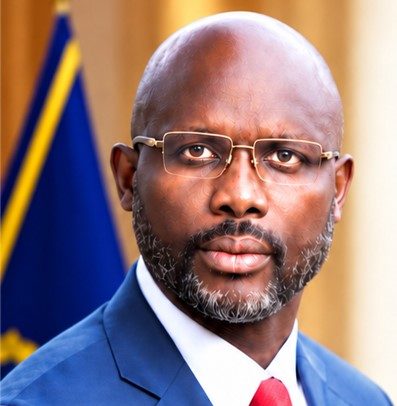
MONROVIA – He was born in the swamps of Clara Town, where the tide crept into the houses and dreams were meant to drown with it. Sixty years later, George Manneh Weah stands as the most improbable success story this republic has produced — the barefoot boy who became the only African ever to win the Ballon d’Or, the waterside child who rose to the highest office in the land, and the President who did the rarest thing in our politics: he handed over power and went home in peace. As Liberia marks his sixtieth birthday on October 1, THE ANALYST cursorily looks back on the life of the man who carried our name farther than any diplomat ever could.
MONROVIA — There is a stretch of water in Clara Town where, on an ordinary evening in the 1970s, you might have seen a thin, quick boy chasing a ball of tied-up rags across the mud — barefoot, tireless, laughing at the sky.
Nobody watching could have known they were looking at a future Ballon d’Or, a future President, a future legend whose name would one day be spoken in the same breath as Pelé and Maradona. But that boy was George Manneh Weah. And on the first of October, he turns sixty.
For a man who has been a footballer, a philanthropist, a senator, and a head of state, the numbers still astonish. One small country. One waterside slum. One life that carried the name of Liberia farther than any diplomat, any treaty, any anthem ever could.
This is not the story we usually tell in these pages. Today we set the criticism down, as a people should on a favourite son’s birthday, and simply remember how far this one man travelled — and how much of the journey he made for us.
FROM THE SWAMPS OF GIBRALTAR
George Weah was born on October 1, 1966, in Monrovia, into the crowded, hard world of Clara Town, in the quarter the people call Gibraltar. His father was a mechanic; his mother a small trader.
When the marriage broke, it fell to his grandmother, the late Emma Klonjlaleh Brown, to raise him — a woman of iron faith and slender means who fed the boy, prayed over him, and kept him straight.
He knew what it was to be hungry, to go without shoes, to play football simply because it was free and it was joy. Liberia in those years offered a poor boy from the waterside almost nothing. Football asked him for nothing but his two feet — and those, God had given him in full measure.
THE WORLD AT HIS FEET
Such talent could not stay hidden in the mud for long. From the local sides — Young Survivors, Mighty Barrolle, Invincible Eleven — he crossed to Tonnerre Yaoundé in Cameroon, and there a young French coach named Arsène Wenger saw what the rest of the world had missed and carried him off to AS Monaco in 1988.
What followed reads like a tale a griot would invent to make children believe. At Monaco, then Paris Saint-Germain, then the mighty AC Milan of Italy, Weah became one of the most feared attackers alive — big, graceful, and impossibly fast, a man who could carry a ball from his own half and leave a trail of defenders sitting in the grass behind him.
Then came 1995, and the summit no African had ever reached, and none has reached since. In that single golden year, George Weah was crowned FIFA World Player of the Year and won the Ballon d’Or — the highest honour in all of world football.
Three times, in 1989, 1994, and 1995, he was named African Footballer of the Year. In 1996 he was declared African Player of the Century. Think of it well: a boy from the Clara Town waterside sat, quite literally, on top of the football world, and the flag behind his name was ours.
HE CARRIED THE LONE STAR ON HIS BACK
Yet the honour Liberians hold dearest is not the Ballon d’Or gathering light on some shelf in Europe. It is this — that at the very height of his fame and his fortune, George Weah never once forgot the small, bleeding country that bore him. Again and again he pulled the Lone Star jersey, number 14, over his shoulders.
And when the nation was too poor and too broken by war to send its team to play, Weah reached into his own pocket. He paid for the jerseys, the air tickets, the hotels, the bonuses, so that the Lone Star could take the field with its head up.
Let the young ones understand what that meant. In those years, when the guns were loud and the news from home was almost always bad, George Weah was often the only good news Liberia had.
He was the one name that could make bitter enemies, for ninety minutes, forget the war and shout for the same flag. He was, in truth, a one-man ministry of hope, waving a green light over a country sitting in darkness.
MORE THAN A BALLER
He was never only a footballer. During his playing days he served as a Goodwill Ambassador for UNICEF, lending his face and his name to the cause of children caught in war and want.
In 2004 the sporting world gave him the Arthur Ashe Courage Award for his humanitarian work. Back home, he founded a youth club, the Junior Professionals, with one unbending rule — no boy could play unless he stayed in school. And in a gesture that says everything about the man, Weah, already a global icon, went back to the classroom himself as a grown man, earning a university degree in business, unashamed to be a student again when most men would have thought themselves far too big.
FROM THE PITCH TO THE PRESIDENCY
When he finally hung up his boots, George Weah could have lived out his days in comfort anywhere on earth. Instead, he came home — back to the very poverty that had shaped him — and offered himself to his people in a new arena.
The road was not smooth. He founded the Congress for Democratic Change in 2005 and lost the runoff that year to Ellen Johnson Sirleaf; he stumbled again in 2011. But the waterside boy had never known how to quit.
In 2014 the people of Montserrado sent him to the Senate with a thundering seventy-eight percent of their votes. And in 2017, they lifted him to the highest office of all, making him the twenty-fifth President of the Republic of Liberia in the country’s first democratic handover of power in seventy-four years.
He came to the Mansion as the people’s own. One of his first acts was to cut his own salary and benefits by a quarter. Under his watch, roads were cut through counties that had never known them, the country’s first kidney dialysis centre opened its doors, schools were built and rebuilt, and thousands of young Liberians walked into tuition-free classrooms at the University of Liberia.
Whatever the arguments about his years in power — and this newspaper has made them, robustly — no honest Liberian can deny that the man never lost the common touch, or the ability to sit on a bench in the community and speak to the smallest citizen as an equal.
THE GRACE OF LETTING GO
And then came the moment that may, in the long run, outshine even the Ballon d’Or. In 2023, George Weah lost his bid for a second term, narrowly, to Joseph Nyuma Boakai. In many corners of our continent, that is where the trouble begins — where men have been known to burn a whole nation rather than give up a single seat. Weah did the opposite.
He picked up the telephone, congratulated his rival, accepted the will of the people, and in January 2024 handed over power in peace. It was, in its own quiet way, the finest goal of his life — a gift not to himself but to Liberia, and proof to the whole world that our young democracy had at last come of age.
THE HOMECOMING
Time away did nothing to cool the people’s love. When he returned home this September, the road from the airport to Monrovia filled with a sea of well-wishers who came, by every honest account, without a single government bus to carry them. They came because they wanted to — because, to a great many Liberians, King George remains exactly that. Today he moves among the elder statesmen of the nation, a voice still listened to, a name still able to fill a road, a man whose season is plainly not yet over.
AT SIXTY
There is a softer chapter, too. In 1993 he married Clar Duncan, and the football gift he was given has passed on to a new generation: his son Timothy Weah now wears the colours of great European clubs and the United States national team, carrying the family name back onto the world’s biggest pitches. The boy from Gibraltar is now a grandfather figure to a whole country.
At sixty, George Manneh Weah is no longer only a footballer, or only a politician. He has become something larger — an institution, a living proof to every child on every waterside in this land that the mud is not destiny, that a barefoot boy with nothing but his feet and his faith can climb high enough to touch the stars and still find his way home.
Few nations are ever blessed with such a son. Liberia has had one, and he is ours.
So today, THE ANALYST sets down its pen of criticism and joins the whole republic in a single, glad word. Happy sixtieth birthday, Mr. President. Happy birthday, King George. May the years ahead be gentle, may your strength hold, and may Liberia never forget how far one of her own once carried her name. Long life, and God’s blessing.
Comments are closed.