

Ellen Redefines Power, Purpose Keynotes Freetown Women Leaders’ Summit
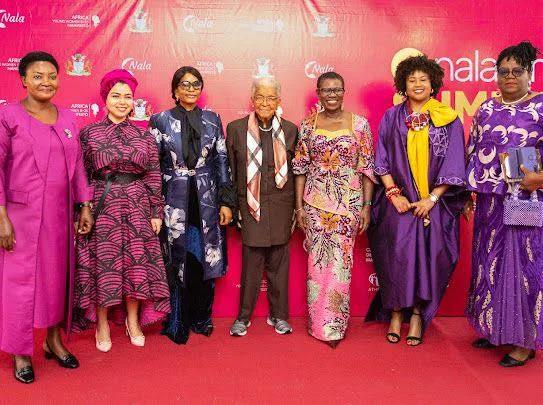
MONROVIA – Ellen Johnson Sirleaf turns 88 today, and her keynote in Freetown last year reads like a manifesto for the occasion. She told the NALAFEM Summit that representation is only the beginning. Her real subject was power and the purpose behind it. Power without a moral compass, she warned, is dangerous. That is a striking admission from someone who held a nation’s highest office. It moves the measure of women’s leadership from presence to performance. She also called Africa’s gains fragile, including Liberia’s own hard-won democratic progress. The speech therefore doubles as an audit of her generation’s legacy. Its closing charge hands the unfinished work to a younger generation of women, as THE ANALYST reports.
Former Liberian President Ellen Johnson Sirleaf told African women leaders gathered in Freetown, Sierra Leone, that representation is not the destination for women in public life but “only the beginning.”
Delivering the keynote address at the NALAFEM Summit on July 2, 2025, Africa’s first democratically elected female president urged women to move from presence in the corridors of power to the exercise of power itself.
The summit was held under the theme “From Representation to Power: Women Leading in Crisis and Peace.” Sirleaf titled her own address “From Legacy to Leadership: Power, Purpose, and Progress,” saying she wished to share “not only what I have lived, but what I believe we must build—together.”
Addressing Freetown Mayor Yvonne Aki-Sawyerr as “my dear sister and host,” along with distinguished women leaders, guests, allies and change-makers from across the continent, Sirleaf described her return to the Sierra Leonean capital as “an honor—and a joy.”
She called Freetown a city “where the Atlantic winds carry the stories of resistance, freedom, and faith.”
“I stand before you today not just as a former head of state, but as a proud African woman, shaped by the struggles of our continent, strengthened by the resilience of its women, and stirred by the possibilities of our future,” she declared.
The summit’s theme, she observed, speaks “not just to a moment—but to a movement.” She described it as “a movement that insists that women’s voices do not belong only in the margins of power, but at its very center,” and one “that understands that representation is not the destination; it is only the beginning.”
Power as Responsibility, Not Title
Sirleaf contended that power is often misunderstood. “It is not just about titles or the corner office. True power is the ability to change lives, to shift narratives, to open doors for others long after we have walked through them,” she stated.
Recalling her 2006 inauguration as Africa’s first democratically elected female president, she said: “I did not inherit power—I inherited responsibility. Responsibility to repair a broken nation, to give dignity to the voiceless, to restore hope in places where hope had grown dim.”
She warned that “power without purpose is empty” and that “power without a moral compass is dangerous.” That, she argued, is why women’s leadership is so urgently needed, “not just for gender equality, but for global stability.”
“Because when women lead, we bring the full force of our lived experience—with its burdens, its brilliance, its quiet strength. We lead differently. We lead inclusively. We lead with integrity,” Sirleaf noted. In times of crisis, she added, as the summit affirmed, women “do not run from the fire, we walk through it, carrying others with us.”
“Our Continent Cannot Afford to Wait”
The former Liberian leader lamented that girls are too often told to shrink their dreams, to defer and to wait their turn. “But our continent cannot afford to wait any longer,” she asserted.
She named climate shocks, conflict, food insecurity and economic exclusion as challenges that “are not abstract statistics” but daily crises requiring urgent solutions.
“And I say to you: There is no more powerful engine for innovation, peace, and progress than African women empowered by purpose,” she stressed.
Purpose, according to Sirleaf, means understanding that leadership is not about self but about service. “It is not about being celebrated, it is about being accountable. It is not about being perfect, it is about being present, being persistent, and being principled,” she maintained.
Turning directly to the women in the hall, she declared: “You belong in every room where decisions are made. Not because you are women—but because you are wise, prepared, and capable.” She cautioned them: “Let no one mistake your kindness for weakness. Let no one confuse your empathy for inexperience. Let your purpose guide you, even when the path is steep.”
Progress Fragile, Must Be Protected
Sirleaf observed that progress is never guaranteed and “must be protected, cultivated, and extended.” She noted that Liberia made hard-won gains in education, governance and women’s rights, “but the work is not done,” adding that across the continent progress remains fragile, “especially in fragile states.”
Gatherings such as the NALAFEM Summit matter, she maintained, because “they are not just symbolic, they are strategic.” She described them as “spaces of truth-telling, coalition-building, and agenda-setting.”
She challenged participants to ask what kind of leadership they want to leave behind, and what legacy they are building “not only in government, but in our communities, our companies, our classrooms.” She called for investment in the next generation of women leaders “not in theory, but in practice.”
“Let us break down the systems that keep women excluded from peace negotiations, from boardrooms, from ballot boxes. Let us use our voices to shape policy, not just protest it. Let us write the rules, not just play by them,” she urged.
“We Are Walking Through It”
Reflecting on her own journey, Sirleaf said she had seen what is possible when women rise and had lived “what it means to lead in the eye of the storm.” She added that she had witnessed, time and again, “that the arc of history bends not by accident, but by action.”
“We are no longer knocking on the door of power—we are walking through it,” she proclaimed. “From Freetown to Kigali, from Monrovia to Nairobi, from rural villages to global forums—African women are not waiting to be saved. We are saving ourselves—and reshaping the world in the process.”
Closing with a charge to the summit, she urged the women to “lead boldly,” to “lead wisely” and to “lead with heart.” When the journey grows hard, “and it will,” she told them, they should remember that they do not walk alone but with “the strength of your foremothers, the prayers of your sisters, and the eyes of your daughters.”
Sirleaf expressed the hope that African women would move “from legacy to leadership—fueled by power, driven by purpose, and always moving toward progress.” She ended her address with a blessing: “Thank you. God bless you. And God bless Africa’s daughters.”
Comments are closed.