
Elections Bills, Others on Deck -Legislature Reopens with Reform Pledges
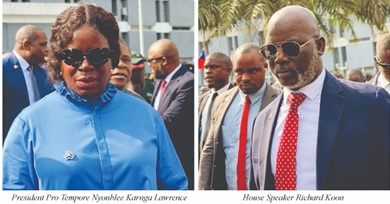
MONROVIA – Liberia’s lawmakers reopened the Third Session of the 55th Legislature with a dual message: sell performance—roads, budgets, bills passed, institutional reforms—and signal next fights—elections law, redistricting, diaspora voting, port-sector decentralization, and internal cleanup driven by audit recommendations. In separate opening remarks, Senate Pro Tempore Nyonblee Karnga Lawrence and House Speaker Richard Nagbe Koon framed the new session as a test of credibility: whether the Legislature can tighten its own administration and still deliver the politically charged reforms the country expects ahead of the 2026 cycle. Their tone, delivered in settings heavy with symbolism—including Providence Baptist Church, invoked as a reminder of constitutional foundations—also reflects a Legislature still recovering from recent turbulence while trying to project unity and command public trust. The Analyst reports.
The Liberian Legislature on Monday formally commenced the Third Session of the 55th Legislature, with Senate Pro Tempore Nyonblee Karnga Lawrence highlighting the Senate’s output from the previous session and Speaker Richard Nagbe Koon detailing administrative reforms inside the House while outlining key legislative priorities for the months ahead.
Lawrence, speaking at the opening of the Third Session of the Senate, praised improved mobility to counties during the recess period, calling the ability to “commute freely” a significant national achievement linked to road access.
She reported that the Senate closed the Second Session on December 18, 2025, and cited performance figures including 59 sittings, 76 pieces of legislation passed, 64 enactments, nine ratifications, and 213 confirmations out of 236 nominees designated.
On oversight and fiscal measures, the Pro Tempore said the Senate adjusted the petroleum pricing regime, which she said expanded revenue for road funds and would support the acquisition of road equipment for counties.
She also pointed to a budget promise—now reflected, she said, in legislative action—to include appropriations for county capitals and salaries for County Council members.
Lawrence further credited legislative committees for supporting Liberia’s successful bid for a non-permanent seat on the United Nations Security Council, saying the Foreign Affairs and Defense & Security committees played a key role.
She also called for regular updates from the committees as Liberia begins its term.
The Pro-tempore She also addressed port-sector legislation, noting that the Legislature recently passed the Port Authority and Port Autonomy bills after correcting lines previously vetoed by the President, and argued the reforms are intended to decentralize economic activity, grow port cities, and create jobs.
Lawrence emphasized that the Port Authority bill is structured to establish a regulatory body for all sea and inland ports, underscoring a separation between regulation and operation.
Internally, Lawrence announced staff-focused reforms, including a process to standardize salaries and a request for the Civil Service Agency to conduct personnel and credential evaluations.
She also directed committees to review the harmonization process affecting civil servants across sectors in pursuit of “just compensation,” with a mandate for Ways, Means & Finance and Public Accounts to begin work immediately and report back within two weeks.
On infrastructure, she said China remains committed to renovating parts of the Capitol complex, including the joint chamber and old building, and instructed Senate committees to coordinate with House counterparts and the Ministry of Public Works to complete a feasibility study.
On compliance and credibility, Lawrence reported progress on recommendations from a system review and audit supported by the General Auditing Commission, saying the Senate has fully and partially implemented some recommendations and has drafted HR and financial policy documents—including performance management, job descriptions, compensation and benefits frameworks, employee handbook policies, petty cash management, fixed asset management, fuel distribution, and funds disbursement.
She said the Senate’s priorities include launching a Strategic Plan (2025–2029), validating and operationalizing HR and financial policies, finalizing compensation frameworks, and institutionalizing manuals.
Speaker Koon, in opening remarks for the House delivered at Providence Baptist Church, cast the opening as a constitutional reminder, urging lawmakers to treat their oath as a living guide rather than a ceremonial recitation.
He described the last session as historic, referencing a leadership change that elevated him to the Speakership, and pledged to lead with what he called a servant posture guided by the collective will of the House and national interest.
Koon highlighted administrative reforms carried out with the Civil Service Agency to professionalize staff and move toward a centralized, transparent payroll system. He said unity-building in the House was also a priority after a difficult period, describing deliberate efforts to heal divisions and restore cordiality.
He said the House requested an audit process with the General Auditing Commission beginning with a systems audit, and that an Internal Audit Department has been established, reinforcing financial discipline alongside the Committee on Public Accounts.
Koon also detailed improvements to legislative facilities, including work nearing completion on the House chamber, modern security upgrades such as CCTV and biometric access systems, and procurement of buses to ease staff transportation challenges.
He said dormant departments were deactivated while essential units like maintenance were strengthened.
On lawmaking priorities, Koon said the House aims to complete the new Elections Law, citing the ECOWAS protocol expectation that key electoral rules be finalized at least a year before elections.
He also pointed to electoral redistricting, describing it as sensitive but constitutionally necessary, and said the House intends to launch a Diaspora Legislative Caucus as part of efforts to advance overseas voting.
Regionally, he said Liberia is positioning to strengthen parliamentary diplomacy, including settling obligations to regional and international legislative bodies to protect voting rights and participation.
He announced Liberia will host the Conference of Speakers and Presidents of African Legislatures (COSPAL) in Monrovia, tentatively September to October, and said progress continues toward full establishment of the Mano River Union Parliamentary Body, with Liberia’s enabling Act awaiting presidential signature.
Both presiding officers framed the new session as an opportunity to deepen reforms, restore trust, and deliver governance outcomes with stronger transparency—setting a high bar for a Legislature entering a politically consequential year.
Comments are closed.