

‘Begin Within,’ -Joekai Wants Book In Liberia’s Classrooms
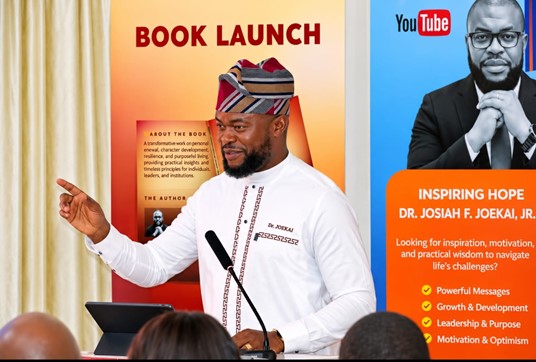
MONROVIA – Since 2024, Dr. Josiah F. Joekai, Jr. has led reform of Liberia’s civil service. Now the Civil Service Agency (CSA) Director General is turning to the person behind the desk. His new book, Self-Cleansing and Renewal for Successful Living, launched on Saturday in Monrovia. It completes a two-book argument. The first exposed gender inequality in Liberian workplaces. The second turns to the inner lives of the people who run them. Its centerpiece, the Joekai Model, maps four phases from awareness to integration. Joekai wants schools and universities to adopt the book. He also invites scholars to test and critique it. That openness lends rare credibility to a work of personal renewal. THE ANALYST reports.
The Director General of the Civil Service Agency (CSA), Dr. Josiah F. Joekai, Jr., has launched Self-Cleansing and Renewal for Successful Living. The book carries Liberia’s reform conversation from institutions to the individuals who run them. At the launch on Saturday, November 21, 2026, at Sinkor Palace, Congo Town, Monrovia, he urged the country’s education authorities to bring the book into the classroom.
Joekai, an author and industrial and organizational psychologist, called on the Ministry of Education (MOE), the National Commission on Higher Education (NCHE), universities, colleges and other educational institutions to act. He wants the book, subtitled A Journey to Inner Healing, Purpose, and Lasting Fulfillment, adopted as prescribed or recommended resource material in relevant academic and professional programs, subject to appropriate academic review.
Addressing officials of government, representatives of academic institutions, members of the diplomatic community, distinguished guests, family and friends, Joekai said he stood before them “with gratitude, humility, and a profound sense of purpose.” He then set out what the occasion meant to him.
“I am not just launching a book. I am sharing a journey, advancing an intellectual conversation, and inviting each of us to reconsider what it truly means to succeed in life,” he declared.
SUCCESS BEGINS WITHIN
Joekai said one of humanity’s greatest contradictions is that people spend so much time building their external lives while neglecting the internal foundations on which those lives depend. “We pursue education, wealth, influence, recognition, and professional advancement. Yet, sometimes, the higher we rise, the heavier the invisible burdens we carry,” he observed.
“We can become successful in the eyes of the world and remain deeply unsettled within ourselves,” Joekai noted. He said this realization is central to the two books he has brought into the public domain in 2026 alone.
Although the two books address different dimensions of human experience, Joekai said, they share one fundamental conviction. “Human progress requires both transforming the institutions that shape our opportunities and transforming the individuals who shape those institutions,” he stated.
REVISITING THE GENDER INEQUALITY STUDY
Joekai recalled that earlier this year he launched his doctoral dissertation, The Effect of Gender Inequality in Liberian Workplaces: Implications for Employee Performance and Well-Being. He described it as an empirical study of the relationship between workplace gender inequality, employee performance, and psychological and professional well-being.
That research, he said, emerged from a fundamental concern. “How can Liberia achieve meaningful national development when unequal workplace experiences may prevent capable individuals from realizing their full potential?” he asked.
According to Joekai, his investigation brought attention to the importance of equitable opportunities, fair treatment, institutional accountability and inclusive leadership. It also highlighted workplace environments in which employees can contribute meaningfully without discrimination.
He invited the audience to consider two employees with comparable qualifications, competence and commitment. If one enjoys greater access to professional development, recognition and advancement simply because of gender, he argued, the consequences extend beyond the disadvantaged employee.
Such inequalities, Joekai warned, can weaken motivation, undermine institutional confidence and diminish the productive potential of the organization. “The lesson is clear. Gender equality is not simply a matter of social justice. It is also a question of organizational effectiveness, human dignity, and national productivity,” he declared.
Recognizing the policy significance of the research, Joekai said, he officially presented the dissertation publication to the Ministry of Gender, Children and Social Protection (MGCSP), the MOE and several academic institutions. He wanted to encourage its consideration in gender policy and framework development, academic research, personnel administration and workplace decision-making.
“I wanted the research to move beyond university shelves and inform decisions that affect real people in real institutions,” he said. “But my intellectual journey did not end there.”
THE ENVIRONMENT WITHIN US
Joekai explained that the dissertation examined how institutional conditions influence human performance and well-being. The new book, he said, explores another equally important dimension: how internal conditions influence people’s choices, relationships, leadership and fulfillment.
“One examines the environment around us. The other examines the environment within us,” Joekai noted. Together, he said, they reinforce a powerful principle: “We must build institutions that respect human dignity while developing individuals who possess the emotional maturity, integrity, and courage to uphold it.”
FROM PERSONAL STRUGGLE TO PURPOSE
Joekai told the gathering that Self-Cleansing and Renewal for Successful Living was born out of a deeply personal realization. At one point in his life, he said, professional advancement and public recognition suggested everything was progressing well.
“Yet, beneath those accomplishments, I carried unresolved disappointments, emotional burdens, and expectations that quietly influenced my sense of fulfillment,” he disclosed. “I eventually discovered that achievement and inner peace are not necessarily the same thing.”
The CSA boss said he had to confront difficult questions. “What was I carrying that no longer served my growth? Which experiences still influenced my reactions? Was I living according to my deepest values, or merely responding to others’ expectations?” he asked. These reflections, he said, helped shape the book.
Joekai stressed that the book is not a declaration that successful people have no problems. Neither, he said, is it a promise that adversity can simply be wished away.
Rather, he explained, it invites readers to confront their internal struggles, understand their influence, release destructive patterns and intentionally cultivate a more meaningful existence. The book contains 10 chapters, beginning with a foundational introduction and progressing through three interconnected parts.
Each part, according to the author, advances a distinct dimension of personal transformation. Each is supported by practical illustrations, reflective questions and opportunities for readers to apply the lessons to their own lives.
PART ONE: THE PATH TO CLEANSING
The first part, The Path to Self Cleansing, addresses the beginning of meaningful transformation: the courage to examine oneself. Through the chapters Unveiling the Layers, Breaking Chains and Embracing Authenticity, Joekai explores the psychological and emotional influences that shape identity, beliefs, behavior and decisions.
He said the book explains how childhood experiences, social expectations, limiting beliefs and unresolved insecurities can quietly determine the direction of people’s lives. He offered the example of a brilliant young woman who repeatedly declines leadership opportunities because she has internalized the belief that she is incapable.
“Her greatest obstacle may not be a lack of ability, but a deeply rooted sense of inadequacy,” Joekai observed. Self-cleansing, he said, begins when she recognizes that belief, questions its validity and develops the confidence to act beyond it.
The same principle, according to Joekai, applies to leaders who mistake criticism for hostility, employees who equate personal worth with professional titles, and individuals who constantly seek approval at the expense of authenticity. “My central argument is simple: We cannot meaningfully transform what we refuse to acknowledge,” he stated.
PART TWO: LETTING GO, HEALING
The second part, Letting Go and Healing, examines the emotional burdens that prevent people from moving forward. Through Releasing the Past, Healing Wounds and Cultivating Resilience, Joekai discusses forgiveness, emotional recovery, self-compassion, support systems and the ability to transform adversity into opportunities for growth.
“I have learned that some of life’s heaviest burdens are invisible. They are the disappointments we never discuss, the betrayals we keep revisiting, and the resentment we carry long after the original experience has passed,” he said.
In the book, Joekai shares his own experience of having to forgive someone who never apologized. That decision, he said, did not erase the experience or excuse the wrongdoing. It let him reclaim the emotional freedom needed for his own development.
He cited an employee who experiences unfair treatment at work. Even after securing another opportunity, he noted, that employee may continue to approach every supervisor with suspicion. Unless the emotional consequences of the earlier experience are addressed, Joekai warned, the past may continue to influence the future.
“Healing does not mean denying injustice. It means refusing to allow painful experiences to permanently control our identity and possibilities,” the author declared.
Joekai also emphasized that serious emotional and psychological difficulties may require professional assistance. Personal reflection and resilience are important, he said, but seeking appropriate support is equally an expression of strength. “My message is that we cannot always control what happens to us, but we can work toward determining what those experiences become within us,” he stated.
PART THREE: CULTIVATING RENEWAL
The third part, Cultivating Renewal, moves from personal healing to purposeful living. Through Mindset and Growth, Habits of Success and Building Meaningful Connections, Joekai examines how individuals can establish the attitudes, routines, relationships and commitments necessary to sustain transformation.
Renewal, he argued, is not merely the absence of emotional pain. “It is the deliberate construction of a life guided by values, discipline, meaningful relationships, and purpose,” he said.
He illustrated the point with a student who fails an examination. The student, he said, can interpret that experience as permanent evidence of inability or as an opportunity to improve study habits and seek academic support.
Likewise, a public servant who makes a professional mistake can conceal it or acknowledge it, learn from it and become more accountable. “In each case, the defining issue is not simply what happened, but how the individual responds and grows,” Joekai noted.
This part, he said, challenges readers to replace temporary motivation with consistent discipline, destructive relationships with meaningful connections, and the endless pursuit of external approval with a more authentic understanding of success. “I want readers to recognize that renewal is not simply about becoming better at what we do. It is about becoming more intentional in who we are,” he added.
THE JOEKAI MODEL UNVEILED
At the intellectual center of the book is Joekai’s proposed conceptual framework, the Joekai Model of Self Cleansing and Renewal (JMSR). The model integrates insights from psychology, sociology, anthropology and moral philosophy to explain personal transformation as a continuous process involving four interconnected phases.
The first phase, Awareness, requires honest recognition of one’s beliefs, emotions, behavior and the experiences that shape them. The second, Release, involves addressing resentment, fear, emotional wounds and other burdens that obstruct personal development.
The third, Reconstruction, focuses on rebuilding healthier beliefs, strengthening resilience, developing productive habits and establishing renewed purpose. The fourth, Integration, occurs when personal growth becomes visible in everyday decisions, relationships, professional conduct and contributions to society.
Importantly, Joekai said, the model is cyclical rather than linear. Integration can produce new awareness, allowing individuals to revisit the process with greater understanding and maturity.
The model further identifies three essential reinforcing dimensions: Conscious Intention, Emotional Stability and Spiritual Transcendence. These, he explained, represent deliberate commitment to transformation, the ability to regulate emotional responses, and alignment with moral values and a deeper sense of meaning.
THE JOEKAI SELF CLEANSING EQUATION
In the book, Joekai expresses these relationships through the Joekai Self Cleansing Equation. The formula reads SC = [(Aw + Re + Rc + Ig) ÷ 4] × (Ci + Es + St).
According to the author, the equation conceptually represents the relationship between the four transformational phases and the three reinforcing dimensions. He said it provides a foundation for further research and possible measurement, rather than a clinically validated diagnostic instrument.
Its underlying message, Joekai said, is that lasting transformation requires more than recognizing a problem. It requires intentional action, emotional maturity, moral direction and consistent application.
He applied the model to a university administrator confronting a pattern of unfair decision-making. Awareness requires recognizing the problem, and Release requires confronting the assumptions or prejudices sustaining it.
Reconstruction requires developing fairer procedures and more responsible leadership habits. Integration occurs when equitable treatment becomes a consistent institutional practice. “That is how personal transformation can contribute to organizational improvement,” Joekai stated.
A BOOK FOR LIBERIA’S CLASSROOMS
Making his case for adoption, Joekai said his appeal rests on the conviction that education must develop more than intellectual competence. It must also cultivate character, emotional intelligence, ethical judgment, resilience and social responsibility, he said.
He said the book offers interdisciplinary relevance across several fields. For Psychology and Counseling, he cited self-awareness, emotional regulation, resilience, personal development and reflective practice.
For Education and Teacher Development, the book addresses student motivation, character development, reflective learning and emotional maturity. For Sociology and Anthropology, it deals with social identity, cultural influences, interpersonal relationships and community renewal.
For Public Administration and Leadership, Joekai pointed to ethical judgment, accountability, emotional intelligence and responsible institutional leadership. For Human Resource Management, the book covers workplace relationships, employee well-being, professional development and organizational behavior.
Peace and Conflict Studies, he said, can draw on its treatment of forgiveness, reconciliation, empathy, conflict transformation and social healing. Philosophy and Ethics can engage its themes of authenticity, moral responsibility, purposeful living and the meaning of human fulfillment.
According to Joekai, the book’s reflective exercises and practical applications make it suitable for classroom discussion, guided learning, leadership development and academic inquiry. He particularly encouraged universities to examine the Joekai Model through scholarly research, test its proposed relationships, and evaluate its applicability across different populations, institutions and cultural settings.
“I am not asking academic institutions to accept every proposition without examination. I am inviting them to investigate, critique, develop, and apply the ideas where they prove educationally useful,” he said.
A university, Joekai argued, should not only produce graduates who know how to earn a living. It should help develop graduates who understand how to live responsibly, manage adversity, respect human dignity and contribute meaningfully to society.
“A nation may produce excellent engineers, doctors, administrators, teachers, and lawyers. But professional competence without integrity, emotional maturity, and social responsibility can undermine the very institutions those professionals are expected to strengthen,” he cautioned.
“We must educate the mind, cultivate the character, and strengthen the human spirit,” Joekai declared. That, he said, is the broader educational contribution he hopes the book will make.
FROM PERSONAL TO NATIONAL RENEWAL
Joekai linked the book to Liberia’s wider development struggle. He said the country’s development challenges require effective institutions, sound policies, capable leadership and responsible citizens.
Yet, behind every institution, he said, are human beings whose values, emotional dispositions, decisions and conduct influence its performance. “A leader who cannot acknowledge personal shortcomings may struggle to accept institutional accountability. A manager who cannot regulate anger may create fear rather than confidence,” he observed.
“A citizen consumed by resentment may find reconciliation difficult, even when opportunities for peace exist,” Joekai added. Conversely, he said, individuals who cultivate self-awareness, emotional stability, integrity and compassion are better positioned to contribute to healthier families, more productive workplaces and stronger communities.
“This is why I believe personal renewal and national transformation are profoundly connected,” he stated. His earlier dissertation, he said, challenges Liberians to examine the structural inequalities that influence workplace experiences.
The new book, by contrast, challenges them to examine the internal conditions that influence their responses, choices and relationships. “Neither approach replaces the other. Personal transformation must never become an excuse for institutional injustice, just as institutional reform cannot eliminate the need for individual responsibility. We need both,” Joekai declared.
THE COURAGE TO BEGIN WITHIN
Closing his presentation, Joekai left the audience with a series of questions. “What are you carrying today that is preventing you from becoming the person you are capable of becoming?” he asked.
“What disappointment have you allowed to define your identity? What fear has persuaded you to abandon a dream? What resentment has occupied a place in your heart for far too long?” he continued. “And perhaps most importantly, what would your life become if you found the courage to confront those burdens and begin again?”
Joekai said he wrote Self-Cleansing and Renewal for Successful Living because he believes past experiences, however painful, need not permanently determine future possibilities. He said he believes achievement without inner fulfillment is incomplete, healing requires courage, forgiveness can create emotional freedom, and purposeful living demands intentional choices.
“I also believe that the greatest contribution we can make to humanity is not simply what we accumulate, but the lives we improve, the hope we restore, and the example we leave behind,” he said. “My invitation today is not that you become someone else. It is that you discover, understand, and develop the most authentic and purposeful version of yourself.”
“Because sometimes, the greatest distance we must travel is not between two countries, two cities, or two professional positions. It is the distance between the person we have become and the person we were meant to be,” Joekai reflected.
“And sometimes, the greatest victory is not defeating an opponent, acquiring a title, or receiving public applause. It is finding peace within ourselves, courage in our struggles, meaning in our experiences, and purpose in our existence,” he added.
Joekai expressed the hope that the book would inspire a generation that measures success not only by what it achieves. Such a generation, he said, would also measure success by what it overcomes, what it becomes and what it contributes to humanity. He thanked the audience for being part of what he called an important moment in his intellectual and personal journey.
“May we find the courage to cleanse, the strength to heal, the wisdom to renew, and the purpose to live successfully,” he concluded. “Thank you, and may God bless you all.”
Comments are closed.