
Court Overturns Its Own Verdict -Tweah Vows Political Resistance as Court Jails Jurors
MONROVIA – A single ruling has exposed deep fractures inside Liberia’s jury system and its fragile justice architecture. By jailing 15 jurors and voiding Samuel Tweah’s acquittal, the Court has framed jury tampering as a threat to democratic order. The decision raises uncomfortable questions about how verdicts are reached and who quietly shapes them behind closed doors. It also thrusts telecommunications data into the heart of judicial accountability. Yet the mistrial reopens a politically charged case, guaranteeing fresh confrontation between the judiciary and Tweah’s supporters. Whether the ruling strengthens public trust or deepens polarization remains genuinely uncertain. As THE ANALYST reports, the outcome will shape perceptions of fairness in Liberian courts for years to come.
The Liberian judiciary has been thrown into a major crisis following a landmark ruling in which the Court ordered the arrest and imprisonment of 15 jurors after finding that their actions compromised the integrity of a criminal trial that ended with the acquittal of defendant Samuel D. Tweah, Jr. The Court set aside Tweah’s not-guilty verdict, declared the trial a mistrial, and ordered a new trial, following an extensive investigation that uncovered what it described as evidence of gross jury tampering and jury misconduct.
The ruling, issued after a detailed review of evidence, ordered that all 15 jurors who served on the panel be arrested immediately, committed to the Monrovia Central Prison, and turned over to the Ministry of Justice for criminal prosecution. It represents one of the strongest actions taken by a Liberian court against jurors in recent history.
Phone Records Expose Violations
The investigation began after allegations surfaced that jurors had secretly possessed and used mobile phones while they were sequestered in the jury quarters during the trial. To determine the truth, the Court subpoenaed telephone records from Orange Liberia and Lonestar MTN involving the jurors and other individuals connected to the case.
The two telecommunications companies submitted hundreds of pages of call logs and text message records, which were reviewed and analyzed by the Court with technical support from representatives of both companies. The analysis revealed that several jurors had access to mobile phones and SIM cards while they were under strict instructions not to have any form of outside communication. Investigators found that calls were made and received and text messages exchanged between jurors inside the jury quarters and individuals outside.
Key Numbers Identified
The Court’s investigation highlighted several telephone numbers that appeared repeatedly in the communication records. According to the findings, telephone number 0886500698 contacted nearly all of the jurors during the sequestration period and also communicated with relatives of some jurors.
Another number, 0886500689, was reportedly in constant communication with several jurors, mainly through text messages. The Court ordered that the owner of the number be identified, investigated, and prosecuted if evidence establishes involvement in attempts to interfere with the jury. The investigation further identified jurors Johnathan Bundoo, Arnold Vincent, and Maximum Dillon as allegedly playing a role in coordinating communications between individuals outside the jury quarters and jurors inside.
Jurors Accused Of Deceiving
The Court found that many jurors were not truthful when questioned about whether phones were present during sequestration. According to the report, several jurors denied having phones or knowing that phones were inside the jury quarters, despite telephone evidence showing communication activities during the trial.
The Court stated that most jurors allegedly met before the investigation resumed and agreed to maintain a common story that no phones existed in the jury quarters. However, jurors Catherine Quawah and Cynthia Tarplah maintained the accounts contained in their affidavits, which the investigation found to be credible.
Premature Case Discussions
Beyond the issue of phone usage, the investigation found that jurors violated court instructions by discussing the case before formal deliberations were authorized. The Court found that jurors discussed the evidence and positions concerning the case while traveling from court, on the jury bus, and inside the jury quarters.
Investigators said disagreements developed among jurors based on their individual views of the case. The Court determined that such discussions violated the jurors’ oath and affected their ability to remain impartial.
Romance Allegation Dismissed
During the investigation, juror Siah Tandanpoli alleged that lawyer Cllr. Augustine Fayiah and jury forelady Madam Harriet Togba had a romantic relationship that influenced the proceedings. However, after reviewing the allegation, the Court found no evidence to support the claim, and it ruled that the allegation was unproven and did not form part of the basis for its decision.
Verdict Declared Tainted
In its final determination, the Court concluded that the conduct of the jurors created a serious threat to the fairness of the trial. The Court explained that jury tampering involves attempts to improperly influence jurors, while jury misconduct involves violations by jurors themselves, including disobeying instructions, unauthorized communication, and premature deliberations.
The investigation concluded that both occurred in the Tweah trial. Because of the misconduct, the Court ruled that the verdict delivered on May 8, 2026, was contaminated and could not stand.
New Trial Ordered
The Court therefore declared the trial a mistrial, set aside Tweah’s not-guilty verdict, ordered a fresh trial before a new jury, and directed the Ministry of Justice to prosecute the jurors and any other persons found involved. The Clerk of Court was instructed to prepare commitment orders, which were handed to the Sheriff to execute the arrest and detention of all 15 jurors.
Integrity Under Spotlight
The decision highlights growing concerns about protecting the integrity of criminal trials in Liberia and ranks among the strongest actions taken against a jury in recent memory. At the center of the alleged attempt to interfere with the investigation is juror George Dennis, whom investigators accused of organizing a plan among jurors to deny that phones were used inside the jury quarters.
Dennis Accused Of Coaching
The investigation found that after the court ordered the recommencement of proceedings, some jurors allegedly met and agreed on what they would say when questioned. According to the findings, the jurors planned to present a united position that no phones were brought into the jury quarters, that no juror used a telephone during sequestration, and that the allegations of jury misconduct were false.
The investigation specifically pointed to Dennis after evidence showed that he contacted fellow juror Catherine Quawah and discussed what jurors had agreed to say. Quawah testified that Dennis informed her about the jurors’ meeting and their decision to deny the presence of phones.
However, Quawah had recorded the conversation, and when the recording was played in open court, Dennis was allegedly heard discussing the agreement among jurors. Although Dennis initially denied Quawah’s account, he later admitted that the voice on the recording belonged to him. The investigation concluded that Dennis’ conduct amounted to tampering with the investigation, because he allegedly attempted to influence testimony and hide information from the court.
Vincent’s Stolen-Phone Claim
Juror Arnold Vincent was also identified as a key figure in the investigation. Before reporting for jury service, Vincent reportedly informed the court that his phone had been stolen during a burglary at his residence, and he used that claim to request assistance from the court to allow his wife access to his bank account while he served.
But investigators later discovered that phone numbers registered to Vincent appeared in call records showing activity during the period of jury sequestration. The investigation concluded that Vincent’s claim of a stolen phone was false and was allegedly designed to conceal his possession and use of SIM cards during sequestration. Investigators described his actions as deliberate and intended to mislead the court.
Bundoo’s Secret Communication
Juror Johnathan Bundoo was also named in the findings. The investigation’s call-log analysis showed that Bundoo’s MTN number 0880812054 was active before and during his jury service, and, according to the report, he allegedly used the phone while inside the jury quarters to communicate with 23 individuals outside.
Despite the evidence, Bundoo denied having or using any phone during sequestration. The investigation found his testimony inconsistent with the telephone records.
Menyongai’s Phone Shared
Juror Lucy T. Menyongai also came under scrutiny. Menyongai denied seeing or using any telephone inside the jury quarters, but investigators said call records showed that her Orange number 0775864936 was active during sequestration and was used to make calls and exchange messages.
The investigation further found that other jurors allegedly used Menyongai’s phone to contact people outside the jury quarters. Her phone was reportedly one of the devices used by fellow jurors.
Dillon Used Others’ Phones
Juror Maximum Dillon was another juror whose testimony was challenged. Dillon denied using or seeing phones inside the jury quarters, but investigators said call records showed that he used phones belonging to Catherine Quawah and Lucy Menyongai to contact his wife, and the investigation found that this evidence contradicted his sworn statement.
Affiants Reveal Operation
Unlike the jurors who denied the allegations, affiants Catherine Quawah and Cynthia Tarplah provided testimony detailing how phones were allegedly introduced and used inside the jury quarters. Quawah admitted bringing a phone into the quarters after arranging for her boyfriend, Abraham Karngbe, to purchase one and leave it in a courthouse bathroom.
She testified that she retrieved the phone and used it while sequestered. She and Tarplah also testified that phones belonging to Lucy Menyongai, Johnathan Bundoo, and Arnold Vincent were used to make calls outside the jury quarters.
Possible Integrity Breach
The investigation concluded that the alleged misconduct involved more than simply violating a no-phone rule. According to the findings, some jurors allegedly smuggled phones and SIM cards into the jury quarters, communicated with outsiders during sequestration, provided testimony contradicted by phone records, and attempted to coordinate their testimony before appearing before the court.
The investigation identified George Dennis as the alleged leader of the attempt to influence testimony, while Arnold Vincent, Johnathan Bundoo, Lucy T. Menyongai, and Maximum Dillon were among jurors whose statements were challenged by evidence. The findings now place the credibility of the jury process under serious examination, as the court considers possible consequences for those accused of interfering with the administration of justice.
Tweah Rejects Ruling
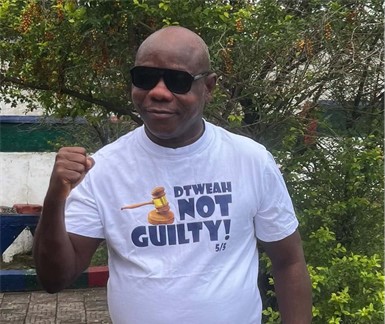
Reacting to the ruling in a public statement, Tweah dismissed the decision and vowed political resistance, declaring that Liberian justice and democracy had taken a major step backward while insisting that citizens were prepared to resist what he called a slide into anarchy. He maintained that no judge, justice, or president could ever change his not-guilty verdict, describing it as etched in the history of the country.
Tweah branded the ruling a “kangaroo” decision and said he had instructed his legal team that his legal journey ended with the original verdict. He stated that he would not submit himself to any Supreme Court process and that his lawyers would file nothing before the high court, adding that the matter had left the realm of law and entered the realm of politics. Describing himself as “a free man” and a “fearless Grebo warrior,” Tweah signed the statement as Samuel D. Tweah, Jr.
Comments are closed.