

UMU Set to Graduate 611 Students Today-As Nyanti Calls for Integrity-Driven Leadership
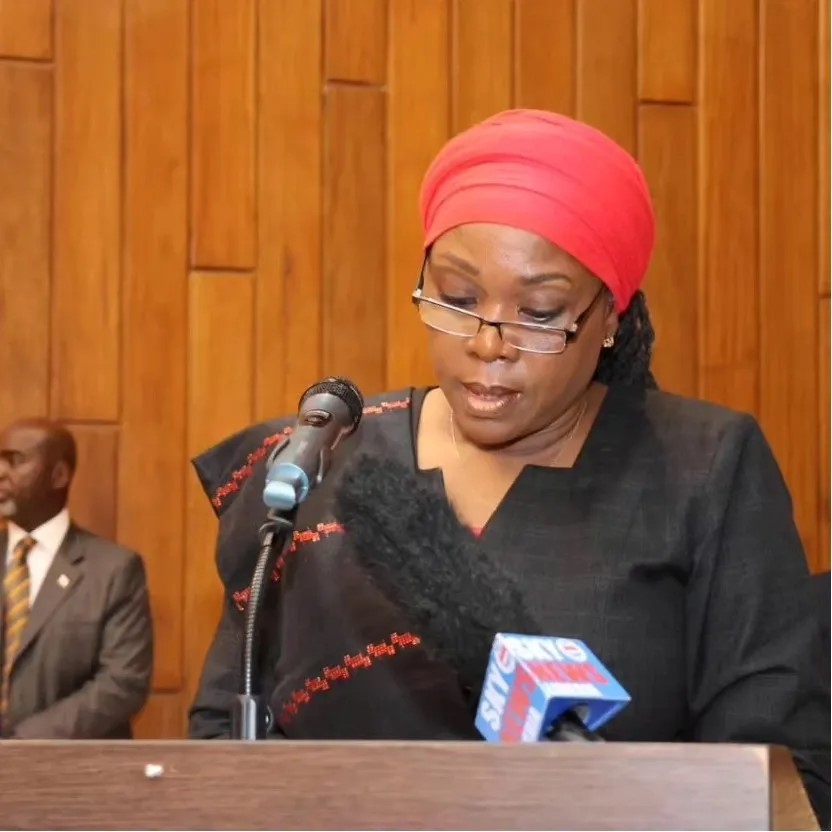
The United Methodist University (UMU) is set to graduate 611 undergraduate and graduate students on today Tuesday in a major academic milestone for one of the country’s leading private tertiary institutions.
The commencement ceremony will be held at the Liberty Christian Center, where Dr. Deborah Rose, President of the Helping Africa Foundation (HAF), is expected to deliver the keynote address before a gathering of students, families, and national leaders.
The graduation follows the university’s 21st Baccalaureate Service held on Sunday at the First United Methodist Church, where Liberia’s Foreign Minister Sara Beysolow Nyanti delivered a stirring message urging the graduating class to embrace responsibility in rebuilding Liberia’s institutions.
The 611 candidates represent a cross-section of disciplines across UMU’s nine colleges, including health sciences, education, agriculture, theology, and information technology—fields seen as critical to Liberia’s development.
From a modest beginning of just over 200 students in 2000, UMU has grown to enroll more than 5,000 students, underscoring its expanding role in producing the country’s next generation of professionals.
Acting President Cllr. Amb. Medina A. Wesseh has reaffirmed the university’s commitment to graduating students who combine academic excellence with strong ethical values.
Nyanti’s Charge: “Be Solutions”
At Sunday’s baccalaureate service, Foreign Minister Nyanti challenged the soon-to-be graduates to redefine the purpose of their education.
Serving as Special Guest Speaker at the UMU 21st Baccalaureate Service Nyanti’s sermon, centered on the theme “Who Will Fix the System?”, resonated deeply with students, faculty, and national leaders in attendance.
Drawing from the biblical account of Moses in the wilderness, Nyanti painted a vivid picture of leadership strained under pressure, emphasizing the importance of delegation and moral character in governance.
“This thing is not sustainable,” she recounted, referencing the counsel given to Moses. “You must appoint people of integrity, people who fear God, love truth, and reject corruption.”
Her message underscored a central thesis: systems do not fail on their own, they fail because of the people within them.
“In the wilderness, when the Israelites came out of their suffering, they were about two million and Moses was responsible to judge every case that they had. Imagine in the wilderness there were difficulties, trials, and he had to judge each and every case that came about amongst them. But then his father in law said to him, “this thing is not sustainable. It is not a sustainable way to manage these issues. And he advised Moses. He said to him, “get you people of great character, men that fear God, men that love truth, men that don’t love to steal what other people have. They don’t covet their neighbors’ wives, they don’t covet their neighbors’ animals, they don’t covet what other people have. And place such people in leadership,” she said.
Drawing her Biblical analogy closer home, Nyanti urged the graduates to view national development through a different prism.
“We must build a system depending on human infrastructure,” she declared. “Organized leadership, accountability, and clear roles are meaningless if the people inside the system lack integrity.
“What are the key requirements? The system will not work if the infrastructure is poor. If the human infrastructure cannot stand, the system will crumble. You need people with integrity. Whether in government, civil society or the community, the human infrastructure is the quality of the people inside the system. The system cannot stand on its own, it is made up of people. You can have all of the hospitals, all of the machines but if you don’t have the people who will use them with integrity, passion and love to the state, the system will not work,” Madam Nyanti said.
“Be Solutions, Not Just Graduates”
In furtherance of her direct appeal to the graduating class, Nyanti challenged students to rethink the purpose of their education, not merely as a pathway to employment, but as a mandate to serve and reform.
“We don’t need graduates who are looking for opportunities,” she said. “We need graduates who will become solutions.”
She criticized complacency in workplaces, describing a culture where productivity is undermined by poor work ethic and lack of accountability.
“Some of you go to work at 9 a.m., leave at 12, return at 2, and want to go home by 3,” she noted. “The infrastructure of the mind must change.”
A Nation in Need of Repair
Nyanti extended her critique beyond institutions, pointing to deeper fractures within Liberian society, families, communities, and governance systems.
“The system of the family is broken,” she said. “In many homes, children are now the providers, and parents have become dependent.”
She also highlighted a culture of complicity, where citizens decry corruption yet perpetuate it through their own actions.
“We complain about corruption, but we are the ones begging those in power,” she asserted. “If the system is not working, why don’t we fix it?”
A Message Rooted in Experience
Beyond her role as Foreign Minister, Nyanti brings a wealth of experience in global diplomacy, humanitarian service, and spiritual leadership. As founding pastor of the Royal Court Parish of the Redeemed Christian Church of God in Lagos, she has authored and distributed over 2,500 daily devotionals across more than 50 countries.
Her leadership extends to education as well, currently serving as Chairperson of the Board of Directors for the Salem Baptist School System.
Introducing the speaker, student representative Mouana Kalilu Coneh praised Nyanti’s “nearly three decades of service to humanity,” describing her as “a transformational leader whose work spans global health crises and international diplomacy.”
UMU: A Legacy of Faith and Learning
Founded out of a vision by the United Methodist Church in the 1970s, United Methodist University has grown into one of Liberia’s leading private institutions of higher learning.
Chartered in 1998 and officially opened in 2000 with just 203 students, the university now boasts an enrollment of over 5,000. Its academic structure spans nine colleges, including programs in health sciences, agriculture, education, theology, and information technology.
The institution’s mission, to provide quality education within a Pan-African context grounded in Christian values, was echoed throughout the baccalaureate service.
Acting President Cllr. Amb. Medina A. Wesseh, in her remarks, reaffirmed UMU’s commitment to shaping leaders equipped with both professional competence and moral clarity.
A Hopeful Vision for Liberia
Despite her candid assessment of Liberia’s challenges, Nyanti’s message was ultimately one of hope and national pride.
“This nation shall be prosperous. This nation will rise,” she proclaimed. “But it will not happen by chance. It will happen because people like you choose to fix what is broken.”
As the ceremony concluded with the resounding notes of Handel’s “Hallelujah Chorus,” the message lingered: the future of Liberia’s systems lies not in policy alone, but in the character and commitment of its people.
For the graduates of UMU, the question now remains: who among them will answer the call to fix the system?
Comments are closed.