

Ngafuan Announces Billion-Dollar Revenue -Links milestone to public welfare
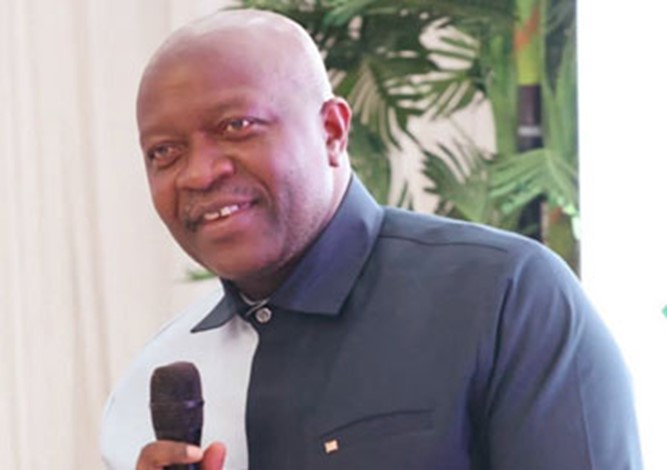
MONROVIA – Liberia’s historic crossing of the US$1 billion domestic revenue threshold gives the Boakai administration both an achievement and a demanding accountability test. Finance and Development Planning Minister Augustine Kpehe Ngafuan announced the milestone Monday during William V. S. Tubman University’s 17th Founders’ Day celebration. The figure signals stronger state capacity after years of postwar recovery, but Ngafuan acknowledged that hardship and urgent public needs remain. His address therefore connected revenue collection to citizens’ daily realities: salaries, medicine, roads, transportation, classrooms, laboratories and scholarships. It also clearly placed Tubman University within that national obligation. Increased support, he argued, must produce transparent procurement, completed infrastructure, stronger teaching, employable graduates and practical research serving communities across southeastern Liberia, as THE ANALYST reports.
HARPER, Maryland County – Minister of Finance and Development Planning Augustine Kpehe Ngafuan has announced that Liberia crossed the US$1 billion domestic revenue threshold for the first time in its 179-year history. He described the achievement as evidence of the country’s growing capacity to finance its development but insisted that the money must improve citizens’ lives.
Ngafuan made the announcement on Monday, September 14, 2026, while delivering the keynote address at William V. S. Tubman University’s 17th Founders’ Day celebration in Harper. He stated that Liberia Revenue Authority Commissioner General James Dorbor Jallah had sent him a real-time image of the government’s revenue dashboard confirming the milestone.
Revenue Achievement Belongs Liberians
“My country, your country has just crossed the historic threshold of one billion United States dollars in domestic revenue collected within a single year,” Ngafuan declared. “For the first time in the 179-year history of our Republic, Liberians are mobilizing domestic revenue on this scale.”
The minister credited President Joseph Nyuma Boakai, Vice President Jeremiah Kpan Koung, Jallah and the Liberian people. He identified market women, salaried workers, compliant businesses, customs officers and revenue agents as contributors to the achievement.
Ngafuan observed that even during many strong prewar years, Liberia’s national budget remained below the present collection level. He cautioned that revenue alone could not prove that every part of life was better, but maintained that it demonstrated expanding postwar state capacity.
Revenue Must Reach Citizens
The minister stated that the significance of the billion-dollar mark depended upon revenue being honestly collected, wisely allocated, carefully spent and publicly accounted for. He connected the collection to salaries, medicine, public transport, roads, laboratories and scholarships.
“The true measure of revenue is not what enters the government’s account,” Ngafuan declared. “It is what enters the life of the citizen: a salary paid on time, medicine in a clinic, a bus reaching a distant county, a road lowering the cost of trade, a working laboratory, or a scholarship that keeps a gifted student in school.”
Ngafuan cited seven vehicles, including ambulances and employee buses, for Jackson F. Doe Memorial Regional Referral Hospital. He also referenced a modern emergency ward under construction, a new 650-kilovolt-ampere generator and improved supplies of medicines and medical materials.
The minister reported observing both progress and urgent needs during a Friday visit to the hospital. He also cited a new College of Nursing complex and auditorium at Grand Gedeh University, alongside investments in roads, schools, health facilities and transportation.
Milestone Does Not Solve Everything
Ngafuan warned that the US$1 billion achievement did not mean Liberia’s accumulated problems had been solved. He stated that no government two years and eight months into its tenure could honestly claim to have resolved problems accumulated across generations.
“A billion dollars is evidence that Liberia has more capacity to do the work, and therefore a greater duty to perform,” he noted. The minister maintained that the revenue increase imposed a heavier obligation on the administration to deliver measurable results.
Two Liberias Need Connection
Ngafuan stated that his journey from Monrovia to Maryland County, including a visit to Grand Kru County, exposed the two Liberias the government must bring together. He reported that the paved road had reached Tappita and that National Transit Authority buses were operating between Zwedru and Fish Town.
He acknowledged continuing concerns about roads, schools, healthcare, employment and transportation. The delegation would carry those realities into preparations for the 2027 National Budget, Ngafuan assured the gathering.
The minister conceded that the government could not fund every request at once because revenue, procurement, logistics, weather and distance affected implementation. He nevertheless declared that scarcity must never excuse indifference.
Tubman Investment Takes Form
Ngafuan reported that approximately US$1.5 million in early government support helped launch Tubman University’s transformation in 2009. He stated that the university received approximately US$6.4 million in the 2026 National Budget, including about US$1.1 million for priority capital works and rehabilitation.
The projects include repairs to the Academic Complex and Elizabeth Davis-Russell Building, renovation of residences, staff quarters, classrooms, the old Engineering Building and the Monrovia office. They also cover perimeter-fence reconstruction, drainage works and construction of the College of Engineering and Technology Building.
“Government is not doing this university a favor by supporting these projects,” Ngafuan declared. “We are carrying out a national duty. The taxes paid by citizens must create opportunity in every region of our country.”
University Rose From Conflict
Ngafuan traced the institution’s beginning to Tubman College of Technology in 1978, when 87 students studied architecture, civil engineering, electrical engineering, electronics and mechanical engineering. He recalled that the civil war interrupted instruction in December 1989, scattered students and faculty and left buildings looted and damaged.
He credited the people of Maryland County for donating land and recognised President William R. Tolbert Jr., former President Ellen Johnson Sirleaf and Dr. Elizabeth Davis-Russell for their roles in the institution’s development and rebirth. He also commended the present Board of Trustees and university President Prof. Dr. Olu Q. Menjay.
An Act signed by President Sirleaf elevated the college to William V. S. Tubman University on September 14, 2009. Ngafuan recalled that critics doubted whether a university could succeed so far from Monrovia amid poor roads, damaged infrastructure, limited faculty and postwar budget constraints.
The university began its new journey with 287 students and now serves nearly 3,000 students across six colleges and more than 20 degree programmes. “What began as seed has become a living tree whose branches reach across the Southeast and the entire Republic,” Ngafuan stated.
Knowledge Must Serve Communities
Ngafuan challenged the university to translate knowledge, innovation and service into practical improvements beyond the campus. He stated that knowledge must enter rice fields, innovation must reach marketplaces and service must extend into villages, clinics, schools, farms, businesses, courts, ports and public institutions.
He described higher education as productive infrastructure because trained professors, laboratories, reliable internet, research grants and scholarships produce the people who build and manage national institutions. Education becomes economic transformation when graduates solve practical problems and create employment, he noted.
Tubman Records Digital Progress
The minister commended the Smart School System for digitising registration, billing, course selection and other student services. He also recognised a locally developed online testing platform and the Liberia Telecommunications Authority’s commitment to improved connectivity.
Ngafuan reported that the Board had approved graduate programmes in Educational Leadership, Business Administration and Construction Management. He stated that those developments showed innovation already existed at the university.
Strategic Plan Faces Measurement
The university’s five-year strategic plan, “Transformation for Worthy Service,” rests on governance, academic excellence, research and innovation, sustainability and infrastructure. Ngafuan stated that its 2028 midterm evaluation must measure employment, business creation, faculty development, research, student life, revenue and completed facilities.
The plan targets employment for 80 percent of graduates within six months, business creation by at least 10 percent within three years and a 20-percent increase in non-government revenue over five years. Ngafuan called on government, businesses, development partners and alumni to help the university meet those targets.
Five-Year Compact Guides Tubman
Ngafuan proposed completing and equipping existing projects before multiplying new construction. He also called for stronger links between learning and work, greater faculty investment, responsible student participation and research focused on southeastern Liberia’s problems.
The research agenda should address coastal erosion, climate-resilient roads, renewable energy, sustainable mining, public health, fisheries, food processing, sanitation and trade. “The best research agenda is the one that improves life outside the university gate,” he maintained.
Students Challenged Toward Service
Addressing students, Ngafuan warned that government could finance classrooms but could not force them to learn or build their character. He urged them to develop competence, communicate clearly, act with integrity, use time wisely and avoid idleness, drugs, dishonesty and distraction.
He encouraged students to remain focused despite poverty, disappointment, peer pressure, family burdens, fear and uncertainty. Intelligence mattered, Ngafuan stated, but discipline, humility, integrity and respect would determine whether knowledge became useful.
Ngafuan urged students to develop ambitions larger than personal advancement and to include Liberia in their dreams. “We cannot log out of our country. We must remain logged in to our country,” he declared.
Southeast Called National Frontier
The minister described southeastern Liberia as a frontier of possibility with fertile land, forests, minerals, fisheries, coastline, cultural wealth and opportunities for trade and tourism. Resources alone could not create prosperity without knowledge, innovation and service, he stressed.
Ngafuan promised predictable government support within budget limits and insisted upon value for money, visible results and completion of ongoing infrastructure. The government would also seek partners for transportation, connectivity, residences, faculty development, research and learning spces.
He described Tubman University as a national university located in southeastern Liberia and serving the entire republic. “Rise, Tubman University. Rise in knowledge. Rise in innovation. Rise in service. Rise for the Southeast. Rise for Liberia,” Ngafuan concluded.
Comments are closed.