

Ngafuan Admits Liberia Imperfect -Concedes electricity, finance, bureaucracy hurdles
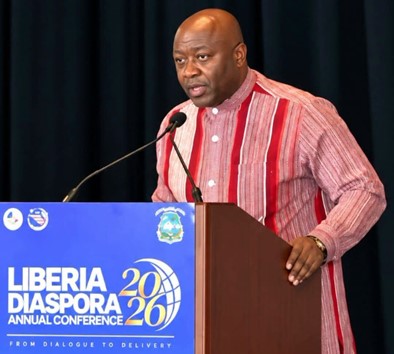
MONROVIA – Finance Minister Augustine Kpehe Ngafuan has reframed the diaspora’s relationship with home. He is no longer asking Liberians abroad to invest out of love alone. He wants them to look home with the cold eyes of an investor. At the recent diaspora conference in Washington, he paired growth figures and a billion-dollar revenue milestone with a rare admission. Liberia, he conceded, remains a hard place to do business. Power is costly, roads are poor and finance is scarce. That candor makes the pitch more credible, and more demanding. The real test now is delivery on the ground. Pundits also believe roads, electricity and payment reforms must reach ordinary people before diaspora capital follows. THE ANALYST reports.
Minister of Finance and Development Planning Augustine Kpehe Ngafuan has delivered a direct message to Liberians living abroad: look home again, but look with the eyes of an investor.
Speaking at the Liberian Diaspora Conference in Washington, Ngafuan acknowledged that Liberia remains a difficult place to do business, with problems ranging from expensive electricity and poor infrastructure to limited access to finance and bureaucratic delays.
But he argued that the country is changing—and that those changes are beginning to create opportunities for Liberians willing to put their money, skills and connections to work at home. His message was blunt: “Bet on Liberia.”
Ngafuan said the argument for investment is no longer based simply on patriotism. Liberians in the diaspora, he said, should examine the country’s economic numbers, infrastructure projects, financial reforms and emerging markets and make investment decisions based on the opportunities they see.
“Liberia is no longer merely a country emerging from crisis. Liberia is a country advancing with purpose,” he told the event.
From Post-War Recovery to Investment Destination?
For a country that spent years struggling with civil war, weak institutions and economic isolation, Ngafuan said Liberia’s record of more than two decades of peace and peaceful political transitions provides an important foundation for investors. He also pointed to Liberia’s role as a non-permanent member of the United Nations Security Council as evidence of the country’s growing international engagement.
But political stability alone does not put money in investors’ pockets. The harder question is whether Liberia can provide the roads, electricity, reliable regulations, financing and public services businesses need to survive. That is where the minister’s broader case rests.
Numbers Behind the Pitch
Ngafuan said Liberia’s economy grew by approximately 5.1 percent in 2025 and is projected to expand by about 5.5 percent in 2026, citing International Monetary Fund (IMF) projections. Mining, construction and manufacturing, he said, remain major contributors to economic activity.
He also cited inflation averaging about 4.5 percent during the first half of 2026 and a broadly stable Liberian dollar. For the 2026 fiscal year, he said the IMF is projecting a primary fiscal surplus of about 2.4 percent, excluding grants.
The minister also pointed to the government’s recent record in passing the national budget before the beginning of the fiscal year and improving the implementation of approved spending plans. “Payment discipline is not a favor from government,” Ngafuan said. “It is part of the infrastructure of trust.” For businesses that depend on government contracts, that trust can be critical.
Revenue Crosses US$1 Billion
One of the government’s strongest financial talking points is domestic revenue. Ngafuan said Liberia’s domestic revenue collection crossed US$1 billion (L$182.36 billion) for the first time by mid-September.
According to figures he presented, domestic revenue increased from approximately US$612 million (L$111.6 billion) in 2023 to US$699 million (L$127.47 billion) in 2024 and about US$848 million (L$154.64 billion) in 2025. But Ngafuan was careful not to portray the billion-dollar milestone as the end of Liberia’s financial problems.
Government still has to finance salaries, education, healthcare, security, infrastructure, county development and debt obligations. “The billion-dollar threshold is not a finish line,” he said. “It is proof of capacity—and a summons to greater responsibility.”
That distinction is important. More revenue gives government greater room to act, but it also raises questions about how effectively those resources are converted into services and development.
Roads Investors Are Waiting For
For businesses operating outside Monrovia, infrastructure remains one of the country’s biggest obstacles. Ngafuan highlighted the government’s ARREST Agenda for Inclusive Development, which includes roads, agriculture, electricity, education, healthcare, sanitation and tourism.
Among the projects he cited is a planned 255-kilometer road network covering parts of Liberia’s western and northern corridors. The projects include routes linking St. Paul Bridge, Klay and Bo Waterside, as well as Voinjama, Kolahun, Foya and Mendikorma.
A bridge across the Cavalla River, linking Liberia and Côte d’Ivoire, is also under construction. Ngafuan disclosed that the project is expected to be completed in March 2028. The government has also procured earth-moving equipment intended to support road maintenance across all 15 counties. For Liberian businesses, the significance is practical: roads determine how easily farmers can reach markets, how quickly goods can move and how much it costs companies to operate outside the capital.
Electricity Remains a Major Test
Despite the government’s progress report, electricity remains one of Liberia’s biggest development challenges. Ngafuan said electricity access has increased from roughly 32 percent in 2024 to about 40 percent in 2026.
He cited electrification work in Buchanan, Voinjama and other communities, alongside expanded connections by the Liberia Electricity Corporation. But for investors, the question is not simply how many people are connected.
The cost and reliability of electricity can determine whether a factory can operate, whether a cold-storage facility can preserve food, and whether a small business can remain competitive. That makes the expansion of Liberia’s power supply one of the practical tests of the government’s investment message.
Can Liberia Process What It Produces?
Agriculture provides another part of Ngafuan’s argument. The government is deploying tractors to support farming and is developing a Special Agro-Industrial Processing Zone in Buchanan.
The facility is expected to support processing of rice, cocoa, oil palm, fisheries products and other commodities. The idea is straightforward: Liberia should not remain primarily a country that exports raw materials and imports finished products.
More processing at home could create jobs and generate opportunities for transportation companies, warehouses, packaging firms, processors, technology providers and other local businesses. But turning that vision into a functioning industrial economy will require reliable electricity, roads, financing, skilled workers and markets.
Moving Money Faster
Another piece of the government’s reform program is financial technology. Ngafuan intimated that the Central Bank of Liberia (CBL) launched an Inclusive Instant Payment System in December 2025.
The system initially connected Lonestar Cell MTN and Orange Money through the National Electronic Payment Switch. According to the minister, it processed more than 1.5 million transactions during its first three months, with a combined value of about L$1.4 billion and more than US$9 million.
The full National Electronic Payment Switch is expected to be completed by March 2027. Ngafuan maintained that the system will eventually connect commercial banks, mobile-money operators, government payment platforms and other financial institutions.
For ordinary Liberians and businesses, the promise is simpler payments, lower transaction costs and faster movement of money. Whether those benefits are fully realized will depend on implementation.
Where Ngafuan Sees the Opportunities
The minister identified several areas where he believes investment opportunities exist. They include energy, roads and logistics, housing, agro-processing, mining services, manufacturing, digital infrastructure, tourism, fisheries, healthcare, education and the wider blue economy.
Liberia’s coastline, mineral deposits, forests, agricultural land and rubber industry, he said, provide a base for investment. He also pointed to Liberia’s membership in the Economic Community of West African States (ECOWAS) and participation in the African Continental Free Trade Area as opportunities for businesses to serve markets beyond Liberia. For the diaspora, Ngafuan sees another advantage: people who understand Liberia but have acquired capital, professional experience and international networks abroad.
“Are We Perfect? No.”
Perhaps the most important part of Ngafuan’s presentation was his acknowledgment that Liberia’s investment environment remains far from perfect. “Are we perfect? No,” he insisted. “We do not present Liberia as a country without problems. We present Liberia as a country increasingly capable of solving problems.”
That is a more complicated proposition than simply telling investors that Liberia is open for business. It asks potential investors to weigh the opportunities against the risks.
The minister acknowledged challenges involving electricity costs, infrastructure, access to finance, bureaucratic delays and regulatory predictability. He also pointed to cooperation with the IMF, World Bank, African Development Bank, European Union, Millennium Challenge Corporation and United Nations as part of Liberia’s broader development financing framework.
Message to Those Sending Money Home
Ngafuan’s most personal appeal was directed at Liberians abroad. For years, diaspora remittances have helped families pay for food, school fees, medical bills, housing and other necessities.
The minister is asking for another kind of diaspora engagement. He wants Liberians abroad to consider putting some of their money, expertise, technology and international connections into businesses that can generate jobs and expand local production. Agribusiness, logistics, housing, tourism, healthcare, education, energy and digital services were among the areas he identified.
But he also warned potential investors not to confuse patriotism with a sound business plan. “Demand sound numbers. Ask hard questions. Structure investments professionally. Seek reasonable returns,” he asserted.
That may be one of the more significant messages from the Washington conference. Ngafuan is not asking Liberians abroad to invest simply because Liberia is home. He is asking them to look at Liberia as a business opportunity and to apply the same discipline they would apply to an investment anywhere else.
Bet Is Not Without Risk
Liberia’s investment story, as presented by Ngafuan, is therefore not a promise of a risk-free market. It is a bet on whether economic growth can be sustained, whether infrastructure projects can be completed, whether electricity access can continue to expand, whether reforms can survive political changes and whether government institutions can deliver more predictably.
Ngafuan described the kind of capital Liberia needs as “patient but not passive; profitable but not predatory; ambitious but also responsible.” For a country still working to overcome the effects of decades of conflict and underdevelopment, that may be the real challenge behind the minister’s invitation.
Liberia needs investors. But investors, in turn, need evidence that the reforms, projects and promises being presented to them will translate into a business environment where their money can work.
Ngafuan’s message to the diaspora was that Liberia is moving in that direction. “Bet on Liberia,” he averred.
Comments are closed.