

LWSC’s Ali Warns Against Self-Importance Says Titles, Authority Temporary; Promises GGU Water
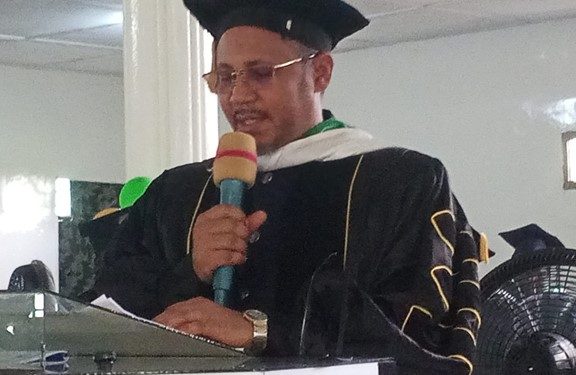
MONROVIA – Mohamed Ali chose an unusual theme for a graduation: the danger of becoming important. The Liberia Water and Sewer Corporation (LWSC) Managing Director told 57 Grand Gedeh University graduates that titles fade and usefulness lasts. The message lands pointedly in Grand Gedeh. The county has produced powerful national figures, yet many residents see little change in daily life. Ali asked what such influence means to a mother who cannot pay school fees. He was equally blunt about the state’s duty: government must govern and institutions must function. Then came the test. The university raised its campus water shortage, and Ali promised engineers this week. Delivery will measure his own sermon, as THE ANALYST reports.
The Managing Director of the Liberia Water and Sewer Corporation (LWSC), Mohamed Ali, has called on the graduating class of Grand Gedeh University (GGU) to reject the pursuit of hollow titles and political vanity and to anchor their lives in integrity, humility and actionable public service.
Ali delivered the keynote address, which blended hard-hitting governance truths with life lessons, at the university’s 8th Convocation in Zwedru, Grand Gedeh County, on Saturday, October 17, 2026, under the theme “The Danger of Becoming Important.”
Ali cautioned the new graduates against the subtle traps of early success, public prominence and the illusion that political office or university degrees automatically equate to greatness.
“Positions are temporary. Authority is temporary. Public attention is temporary. But the consequences of our actions last far beyond the offices we occupy,” he stated.
“Education can make you arrogant, impatient, and convinced that a title makes you superior. Or it can make you wiser, more compassionate, more capable, and more committed to service. The choice belongs to you.”
Education as a Bridge
In one of the most resonant passages of the address, Ali delivered a sharp critique of how education is often used for individual advancement at the expense of societal progress. He told the graduates:
“A university degree should not merely improve your chances of escaping difficult circumstances. It should increase your capacity to change those circumstances. Too often, we treat education as a personal ladder. We climb it, reach a better position, and then pull it away from those coming behind us. But education should also be a bridge: between knowledge and opportunity, between professional success and community progress, and between the Liberia we have inherited and the Liberia we want to build.”
He reminded the graduates that they did not study merely to catalog what is wrong with society, but to develop the capacity to help make things right.
Useful Before Important
Directing his charge at the graduates’ immediate future, Ali stressed that society is rarely transformed by people who are merely celebrated or given high titles. Instead, he said, true influence is built when individuals focus on developing practical capacity, solving real problems and making meaningful contributions to the daily lives of those around them before seeking public distinction.
He warned the graduates against spending their lives chasing empty prestige, reminding them that title-driven prominence without substance quickly vanishes, leaving no lasting legacy.
Real value, he argued, lies in character, quiet dedication and the tangible relief an individual brings to suffering communities. “Do not spend your entire life trying to become a big person. Spend your life becoming a person whose absence would leave a meaningful gap. When the titles are gone and the applause has ended, one question will remain: WAS YOUR LIFE USEFUL?” he said.
Lessons From a Tree
Likening true leadership to a quiet, fruit-bearing tree that offers shade and shelter without demanding praise, Ali told the graduates: “Think about a tree. A tree does not announce its importance. It does not demand a special chair. It does not insist on being called Honorable. It simply grows.” He added: “Grow in knowledge, character, and achievement. But as you rise, provide shade for somebody else. As you prosper, create opportunities for others.”
He urged the graduates to measure their lives not by the titles they hold or the applause they receive, but by the lives they improve and the institutions they strengthen. “When the titles are gone and the applause has ended, one question will remain: WAS YOUR LIFE USEFUL?” Ali asked again.
Life After Office
Offering a humorous yet poignant reality check on the fleeting nature of political power and administrative titles, the LWSC boss reminded the audience of life after office.
Ali posited: “One day, whatever position you acquire will come to an end. If you become a minister, one day you will no longer be minister. If you become a managing director, somebody else will eventually occupy your office. The official vehicle may be returned; the telephone may stop ringing; the invitations may become fewer; and the people who once hurried to greet you may suddenly become very busy! That is not tragedy; that is life.”
Acknowledging the joyous milestone of the Class of 2026, Ali stressed that celebration must be tempered with civic consciousness, noting that tomorrow’s challenges, from youth unemployment to struggling public services and health systems, will not vanish simply because a new class has graduated.
“They will recede only when educated citizens step up, he said. While clarifying that graduates are not expected to shoulder the burdens of government alone, stating firmly that “government must govern, institutions must function, public resources must be managed responsibly, and the private sector must create employment,” he maintained, adding that individual civic contribution is non-negotiable.
‘Invisible Signatures’ on Certificates
A deeply emotional highlight of the address was a tribute to the parents, market women, farmers and extended relatives whose silent, daily sacrifices made the graduation possible.
Ali reminded the assembly that degree certificates carry the “invisible signatures” of unsung heroes who may never step onto a university campus.
“Somewhere in this gathering is a father who wore the same pair of shoes for years because his child’s tuition was more important than his own comfort,” Ali observed. “Somewhere is a mother who woke up before sunrise and returned home after sunset, selling pepper, rice, palm oil, or charcoal in the market to keep her child in school. Her name will not appear on the certificate either… But there are names that deserve to be written on those certificates, names that will never appear there.”
He extended praise to uncles, aunts, grandmothers and community members who shared books, offered accommodation and contributed prayers to ensure that students completed their studies.
Redefining Grand Gedeh’s Legacy
Turning his focus to the host county, Ali challenged local pride and historical measures of success, arguing that Grand Gedeh’s true worth cannot be measured solely by the political heavyweights it has produced.
He asserted further: “Grand Gedeh has contributed significantly to Liberia’s political history and national life. It has produced influential personalities and people who have occupied important positions. But the future of Grand Gedeh cannot be measured only by the prominence of those who come from this county. We must also ask: What difference does their success make to the people who live here? What does political influence mean to a mother who cannot afford school fees? What does a prestigious appointment mean to a young graduate searching for an opportunity? What does public recognition mean if communities experience little improvement in their daily lives?”
True development, Ali noted, requires robust institutions, public investment, private enterprise and collective effort, and individual success must deepen one’s social responsibility rather than diminish it. He added that grassroots development, such as successful local enterprises, improved schools and functioning health facilities, matters just as much as national headlines.
In his final charge, the LWSC Managing Director told the graduates: “The greatest contribution a county can make is not mainly to produce powerful individuals. It is to produce those whose knowledge, influence, and resources improve society. Grand Gedeh University must produce problem-solvers, innovators, entrepreneurs, and professionals prepared to serve… You do not have to wait until you become nationally prominent before contributing to Grand Gedeh.”
He concluded: “I hope you become successful. I hope some of you become wealthy, influential, and entrusted with the highest offices in our country. But above all, I hope you become useful to your families, your communities, your institutions, Grand Gedeh, and Liberia.”
Water Shortage Pledge
Responding to a request to address the acute shortage of water supply on campus, Ali promised that a team of LWSC engineers will visit the campus this week to assess the situation with a view to prompt intervention. The pledge received a thunderous ovation from the audience.
A citation read on behalf of the university by the Chairman of the Board of Trustees (BOT), Chief Dr. William Deiyan Towah, Sr., shortly after the keynote address, highlighted Ali’s career path, including his steady rise to national prominence and his contributions to the nation. The citation particularly praised his stewardship at the LWSC, which it said he has transformed from a dormant public institution into a viable entity that has attracted international donor funding.
GGU Nursing Program Returning
Earlier, in his state of affairs address, GGU President Dr. Eric ZM Gbotoe narrated the challenges the university has encountered but said they are being addressed, and praised the national government for its support. “We inherited an institution seriously challenged in areas that should have allowed it to proceed beyond what it should have been. We were resolved to tackle those problems,” he said.
Gbotoe announced that the deactivated nursing program will soon be in full operation, as the university has met all requirements of the regulatory institution, including construction of a simulation laboratory he described as the largest in the country, and is now awaiting revalidation.
“We have taken steps to expand our capacity building initiatives by sponsoring 14 of our teachers with Bachelor’s degrees to pursue Master’s studies at the Cuttington University and will continue to undertake similar initiatives so that academic excellence will flourish here at the Grand Gedeh University,” he said.
For his part, BOT Chairman Towah praised the national government for the support the institution continues to receive, including a strong indication of a budgetary increase in the next fiscal year.
Goodwill messages came from prominent citizens, government entities and international institutions, prominent among them one from sister universities and colleges, read by Rev. Dr. Solomon K. Jappa, President of the Sinoe Community College. A total of 57 students graduated in disciplines including Business Management, Accounting, Public Health, General Agriculture and Education.
Comments are closed.