

‘Constitution Not Silent’ -Quioh warns against rushing electronic voting
MONROVIA – Liberia’s Diaspora has long demanded the vote. Rep. Thomas Romeo Quioh has now mapped the legal road. Speaking in Columbus, Ohio, the House Elections Committee chairman made a precise argument. The Constitution already permits absentee voting. What Liberia lacks is the statutory machinery. That machinery once existed. A 2004 amendment deleted it. Quioh’s six-step plan is notable for its caution. He wants supervised in-person voting at diplomatic locations first. He warns against rushing into electronic voting. He also separates dual citizenship from overseas voting, two issues often confused. With the 2029 elections approaching, the clock is real. As THE ANALYST reports, cost and credibility, not principle, now stand between the Diaspora and the ballot.
COLUMBUS, OHIO — Liberians living abroad should not lose their right to vote simply because they live outside Liberia. That was the central message delivered on November 21, 2026, by Hon. Prof. Thomas Romeo Quioh, Chairman of the House Committee on Elections and Inaugurations of the 55th National Legislature.
Quioh spoke at the Liberian Diaspora 2026 Summit, held at the Fisher College of Business, The Ohio State University. The summit was organized by the All Liberian Conference on Dual Citizenship (ALCOD) and The Ohio State University’s Center for African Studies. It focused on the theme: “The Legal Pathway to Out-of-Country Voting: Advancing Democratic Inclusion and the Voting Rights of Liberians Abroad.”
In his keynote address, Quioh said the gathering was more than an academic discussion. He described it as an opportunity for Liberia to confront a fundamental democratic question: Can a Liberian citizen living abroad still participate in choosing the leadership and future of the country of his or her citizenship?
Constitution Already Recognizes Absentee Voting
Quioh argued that the legal conversation must begin with the Constitution, not with the assumption that it is silent on the issue. He cited Article 77(b) of the 1986 Constitution, which provides that every Liberian citizen 18 years and above has the right to register and vote.
He also cited Article 80(c), which provides that a citizen has the right to vote in the constituency where registered, either in person or by absentee ballot. “The Constitution is not silent on absentee voting. It is not,” Quioh stated. “However, we must distinguish between the recognition of a constitutional right and the existence of an effective statutory mechanism for exercising that right from outside Liberia.”
The Gap in the Elections Law
According to Quioh, the New Elections Law of 1986, as amended, is still structured around voting where a person ordinarily resides in Liberia. He pointed to a critical piece of history.
Section 5.5 of the Elections Law once allowed a registered voter absent from Liberia to request an absentee ballot from the National Elections Commission (NEC) by registered mail 45 days before an election. That provision was deleted through a 2004 amendment. “This demonstrates that the idea of voting from outside Liberia is not entirely new to our electoral jurisprudence,” he noted.
Dual Citizenship Versus Overseas Voting
Quioh drew a clear distinction between two issues often confused in public debate. He noted that Liberia’s 2022 amendment to the Aliens and Nationality Law allowed Liberians to hold another citizenship without automatically losing Liberian citizenship.
But he stressed that dual citizenship concerns nationality, while out-of-country voting concerns how an eligible citizen exercises electoral rights while abroad. “Statutory recognition of dual citizenship does not, by itself, establish an overseas voting system,” he explained. “Nor should restrictions on eligibility for elected office be confused with eligibility to register and vote.”
Six Steps for Overseas Voting
As Chairman of the Elections Committee, Quioh outlined six critical areas requiring legislative and institutional action. The first is to amend the Elections Law.
He called for a comprehensive review of the law and consideration of a dedicated chapter on Out-of-Country Voting. Such a chapter, he said, should cover eligibility, registration, voting methods, ballot handling, counting, and dispute resolution.
Second, he called for clarifying the role of the NEC. He proposed empowering the commission to establish and supervise overseas registration centers and polling stations. He said it should also issue regulations on identification, verification, ballot distribution, and monitoring, while its independence is protected.
Third, Quioh urged a credible overseas registration system. He said it should securely verify citizenship, age, and identity, and prevent double registration and double voting. He suggested considering biometric registration integrated with the national database, adding that embassies and consulates could serve as registration and voting centers.
Fourth, he said Liberia must decide how Liberians abroad will be assigned to electoral constituencies. “A Liberian from Sinoe County residing in Ohio should not lose the connection between his voting rights and the appropriate Liberian constituency simply because of residence abroad,” Quioh illustrated.
Fifth, he called for protecting electoral integrity through ballot secrecy, secure transport, independent observation, transparent counting, and clear dispute procedures. He recommended starting with supervised in-person voting at diplomatic locations. He warned against rushing into electronic voting without proven cybersecurity, transparency, and public confidence.
Sixth, Quioh urged adequate financing and capacity building. He said the NEC must have resources for equipment, personnel, voter education, diplomatic coordination, transport, and security. “We must avoid creating a legal entitlement without the institutional and financial capacity to implement it,” he cautioned.
Lessons From Other African Countries
Quioh said Liberia should not reinvent the wheel. He pointed to Ghana, Nigeria, South Africa, and Senegal as useful comparative examples.
He said Liberia must study what worked and what failed, and adapt the lessons to its own Diaspora distribution, diplomatic capacity, and finances. “The objective should not simply be to announce that overseas voting has been authorized. The objective is to establish a system that can be implemented credibly and sustainably,” he maintained.
Roadmap to 2029
With the 2029 general and presidential elections approaching, and the NEC’s 2026–2030 Strategic Plan already in place, Quioh proposed a practical roadmap. It begins with a joint legal assessment by the Legislature, the NEC, and the Ministry of Justice, followed by legislative action to amend the Elections Law.
The roadmap also calls for an NEC operational framework, cost estimates, and a voting model. It includes Diaspora consultations in the United States, Canada, Europe, Africa, and elsewhere, as well as pilot implementation in selected locations before full rollout.
Quioh further proposed extensive voter education. He also called for a national stakeholder working group that includes the Legislature, the NEC, the Ministries of Justice and Foreign Affairs, political parties, civil society, Diaspora groups, and development partners. He stressed that the process must be national, not partisan.
Call to the Diaspora
Quioh urged Diaspora organizations to move beyond advocacy and become active partners. He asked them to provide reliable data on Liberians abroad, support voter education, participate in consultations, and support research and capacity building, while respecting Liberia’s sovereignty and electoral laws.
“The Diaspora is not a political party or a single political constituency,” he said. “It is a diverse community… The framework must therefore be inclusive, transparent and nonpartisan.”
Commitment to Reform
Reaffirming his commitment as Committee Chairman, Quioh said electoral reform is about strengthening institutions, expanding participation, and building public confidence. He said the discussion should also advance women’s representation, youth participation, and the inclusion of persons with disabilities.
Quioh Honored with Leadership Award
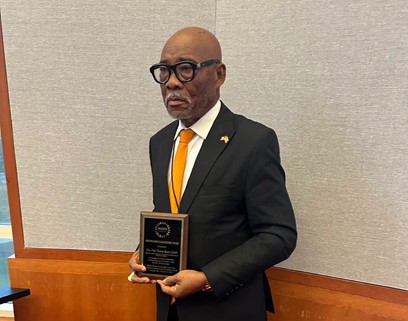
In a highlight of the summit, Quioh was presented with the Distinguished Leadership Award by ALCOD at the Liberian Overseas Voting Rights Summit 2026 in Columbus, Ohio. The honor underscored the central theme of his address: that Liberians abroad must have a credible, lawful pathway to participate in Liberia’s democracy.
One Liberia, One People
In closing, Quioh returned to his opening question: Should a Liberian lose the chance to shape Liberia’s future simply because that citizen lives outside its borders? “Out-of-Country Voting is not a favor to the Diaspora. It is a matter of democratic inclusion,” he declared.
“Liberia belongs to all Liberians. Whether a citizen resides in Greenville, Monrovia, Ganta, Zwedru, Philadelphia, Columbus, Toronto, London or elsewhere, our national identity and collective responsibility to the future of Liberia remain important,” Quioh said. He ended with a call to action: “One Liberia, one people, one democratic future.”
Comments are closed.