

AFD’s STRIVE Project Closes -Delpuech Urges Government Ownership of TVET
MONROVIA – Donor projects in Liberia often fade when the donor money ends. The closing of the €10 million STRIVE Project revives that familiar fear. For six years, the French Development Agency financed vocational training for more than 2,000 young people. Workshops, curricula and a hospitality center now pass into Liberian hands. French Ambassador Dominique Pierre Delpuech was frank about the risk. Sustainability, he said, depends on government ownership. AFD went further, demanding genuine private sector partnerships. The stakes are national, not merely institutional. Young people make up about 75 percent of the population. Many already labor in precarious, low-productivity informal work. Whether Liberia keeps these gains will shape its jobs future. THE ANALYST’S H. Matthew Turry reports.
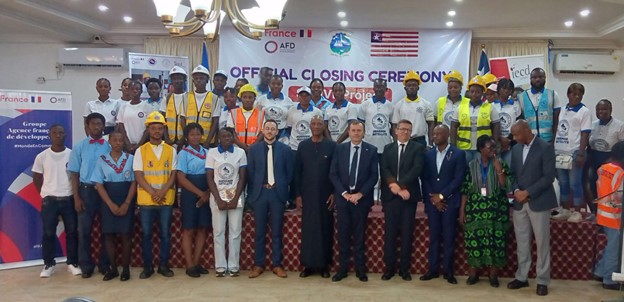
The €10 million Strengthening Integration Through Vocational Education (STRIVE) Project formally closed on Thursday, November 12, 2026. French and Liberian officials and development partners used the occasion to call on the Government of Liberia and the private sector to sustain the project’s gains in technical and vocational education and training (TVET).
Funded by the French Development Agency (AFD) and implemented by the European Institute for Cooperation and Development (IECD) in collaboration with the Ministry of Education (MoE), STRIVE was established in July 2020. Over six years, it supported more than 2,000 young people in electricity, hospitality, masonry and agriculture across four counties.
Speakers at the closing event, which included a roundtable on TVET financing, said the project’s real test will be whether its curricula, equipment and institutions endure.
France Ties TVET to Development
Speaking at the occasion, French Ambassador to Liberia Dominique Pierre Delpuech said TVET is “not merely an education policy issue” but a key driver of Liberia’s economic and social development.
He noted that TVET is part of the Government’s ARREST Agenda for Inclusive Development, under Pillar 1 on Economic Transformation and Pillar 6 on Human Capital Development.
Delpuech acknowledged that employment and employability remain among Liberia’s major challenges. A significant proportion of the workforce relies on informal employment, he said, often marked by precarious conditions, low productivity and limited opportunities for professional development.
Addressing this, he said, requires a stronger, more inclusive TVET system with training closely aligned to labor market needs.
The envoy stated that France, through AFD and IECD, has supported the sector by investing in training infrastructure and equipment, developing curricula and strengthening trainers’ capacities.
He described education and youth as central to French international cooperation, noting that France is the third-largest contributor to the Global Partnership for Education. He added that young people make up roughly 75 percent of Liberia’s population, which he called both “a considerable opportunity and a major responsibility.”
Government Urged to Take Ownership
While praising STRIVE’s achievements, Delpuech cautioned that infrastructure, equipment and training programs alone cannot guarantee long-term results. Sustainability, he said, “ultimately depends on the ownership and commitment of the Government of Liberia.”
He said the Ministry of Youth and Sports (MYS) and MoE have particularly important roles in continuing STRIVE’s activities, maintaining infrastructure and equipment, and mobilizing the human and financial resources needed.
The ambassador also urged the Government to look beyond TVET and treat human capital development as a continuum from basic education to professional integration.
Strong foundational education, he maintained, is a prerequisite for effective vocational training. He also called for stronger links between training and the labor market, including an enabling environment for companies to take on interns and apprentices and eventually recruit them.
France and its development partners, he said, remain committed to supporting the Government in improving the quality and relevance of vocational training, access to inclusive basic education and the links between education and employment.
AFD: “Skills Acquired” the True Measure
Speaking for AFD, Elliott Sotty thanked partners including the Ministry of Finance and Development Planning (MFDP), the Ministries of Youth and Sports, Education and Agriculture, the European Union (EU) Delegation, the United Nations Industrial Development Organization (UNIDO) and the United Nations Educational, Scientific and Cultural Organization (UNESCO).
He credited IECD’s teams for their work over the past six years.
Sotty said AFD has committed nearly €62 million in grants to Liberia since 2018, across employment and vocational training, health, urban development and biodiversity. The €10 million STRIVE grant, he said, has become one of the agency’s flagship interventions in human capital development.
He noted that the project helped improve and harmonize training curricula, modernize technical training facilities and strengthen trainers’ technical and pedagogical capacities.
“The real measure of success is not the number of classrooms renovated or equipment delivered,” Sotty said. “It is the skills acquired, the opportunities created and the lives that can change as a result.”
He said he had visited all the STRIVE-supported training centers and seen motivated students and committed trainers. Sotty then made a pointed appeal to the private sector.
Training centers, he said, cannot operate in isolation from the companies that will employ their graduates, and the country needs to “move beyond dialogue and build genuine partnerships.”
He called for companies to be more directly involved in shaping curricula and identifying skills gaps, and for more internships, apprenticeships and work-based learning, so that the transition to employment begins during training rather than on graduation day.
He also raised long-term financing, noting that quality training requires adequate infrastructure, modern equipment, qualified trainers and regular investment in maintenance. “Investing in skills is therefore not just a social responsibility; it is a business investment,” he said.
IECD Outlines the Project’s Reach
IECD Country Director Alexandre Vial said STRIVE worked with training institutions, public authorities, employers, instructors, farmers and young people to support practical skills development and economic inclusion. “Vocational education is strongest when learners can connect what they study with what they can do,” he said.
According to Vial, the project developed and implemented national curricula, provided technical support to the Ministries of Education and Youth and Sports, and put in place a Quality Assurance Framework. It also built the capacity of TVET Bureau staff, developed Master Trainers and strengthened institutional governance.
He said STRIVE promoted gender inclusion by encouraging young women to enter traditionally male-dominated technical fields, and trained market gardeners in agroecological practices to improve sustainable agricultural production. Vial said continued equipment maintenance, capacity building, institutional collaboration and government ownership will be essential to preserving these gains for future generations.
Systems Built to Endure
STRIVE Senior Manager Adelphe N’Dorman recalled the challenge that prompted the project. Many young people were being trained but not finding jobs, training was not sufficiently aligned with employers’ needs, and many vulnerable youths lacked a genuine pathway to integration.
He said the project’s mandate was to make training more practical, relevant and inclusive and to create employment opportunities for young Liberians.
N’Dorman said STRIVE was guided by a principle of technical efficiency, citing economists Eric Hanushek and Marlaine Lockheed on using limited resources to promote society’s objectives as fully as possible. “We did not merely expend resources,” he said. “We built systems intended to endure.”
He thanked the French Government and AFD, development partners including UNIDO, UNESCO and the Deutsche Gesellschaft für Internationale Zusammenarbeit (GIZ), and implementing partners including Sister’s Hand, Catalyst, Cari and Apdra.
He also thanked TVET institutions, instructors, private sector actors, staff and the young people involved. “We are gathered here today not to close a file, but to recognize the work accomplished,” he said, before declaring the STRIVE Final Recognition Event open.
Ministry Hails Reshaped Training
Zizi Cyrus, Director for TVET at MYS, said the project “fundamentally reshaped how we prepare our young people for the world of work.” When STRIVE began, she said, training was too theoretical and too disconnected from what employers needed.
She cited the Business and Domestic Occupational Training Center (BDOTC), which she described as Liberia’s first purpose-built hospitality training center. The facility, valued at over US$1.2 million (L$218.83 million), has six international-standard guest rooms, a commercial kitchen, a baking laboratory and a training restaurant. Students, she said, no longer learn cooking on charcoal stoves but on the same gas and electrical equipment used in leading hotels.
She recalled Minister Cornelia W. Kruah’s remark at the dedication that the center “represents more than just a building, it is an investment in Liberia’s young people and in the future of our economy.”
In April 2026, Cyrus said, IECD formally handed over fully equipped workshops in electricity, masonry and hospitality to the Ministries of Education and Youth and Sports. “This is both a trust and a responsibility,” she said.
She said STRIVE introduced the Program for Reflective and Operational Facilitation (PROF) to instructors, helping them shift from “teaching what they know” to “teaching what the market demands.”
Instructors also learned to design practical lessons, use ICT tools and apply gender-sensitive teaching methods.
Private employers, including Firestone Liberia, have hired STRIVE-trained youth, she said, which shows that “when training aligns with market demand, Liberia’s young people can compete.”
She credited AFD for its €10 million investment, thanked IECD, and acknowledged UNIDO and the EU for their contributions to the BDOTC infrastructure. She said the Ministry commits to safeguarding the gains and pushing forward with TVET reform.
EU and UNESCO Reaffirm Support
EU Program Officer Lorpu Scott commended AFD and IECD and said investing in skills means investing in people and decent employment.
Technical and vocational education, she said, must equip young people with practical competencies, respond to employers’ needs and create opportunities for women and men alike.
She said strong national ownership, continued private sector engagement and support for training institutions are essential, and that the EU remains committed to working with Liberia on inclusive, quality education and skills development.
UNESCO Liberia Project Officer Joel Muriungi Mutea said the occasion should be seen not simply as the end of a project but as a chance to consolidate and sustain its gains.
He said STRIVE addressed fundamental challenges in the sector, including the relevance and quality of training, instructor capacity, infrastructure and equipment, and the disconnect between skills and labor-market opportunities.
He highlighted the project’s integrated approach, which connects institutional capacity development with employability and economic opportunities, including support to agricultural value chains.
Mutea said UNESCO’s work on policy, governance and institutional frameworks complements IECD’s focus on the operational capacity of training institutions. He said the experience from STRIVE offers useful lessons for wider sector reforms, particularly in curriculum development and assessment.
Roundtable Recommendations
Alieu Kemokai read the consensus recommendations of the roundtable resolution. The resolution held that a hybrid financing approach is the most practical and sustainable option for Liberia, and that the establishment of a National Training Fund should be prioritized.
It described passage of the TVET Commission/LITCOM Act as critical for effective governance and financing. It also declared stronger partnerships between government, industry, donor partners and TVET institutions essential.
The roundtable further recommended that TVET institutions be encouraged to develop self-financing mechanisms. It called for investment in qualified instructors, equipment and infrastructure to improve training quality. It also stressed that TVET programs must stay responsive to labor-market needs to improve graduate employability.
N’Dorman closed the project’s remarks by saying that while STRIVE concludes as a project, “its spirit continues in every skill acquired, and in every young person now engaged in dignified work.”
Comments are closed.