
2026 Budget Hearing Brouhaha -Dillon Disagrees with Bility Over Separate Hearing
MONROVIA – Prominent lawmakers from both wings of the National Legislature are engaged in a heated academic and political debate regarding established procedures and traditions for handling a national budget submitted by the President or the Executive Branch. Nimba County Representative Musa Bility cites constitutional provisions, arguing that the House of Representatives, which traditionally receives the budget, should hold public hearings before forwarding it to the Senate. However, Montserrado Senator Darius Dillon counters that both wings can lawfully hold simultaneous hearings. The disagreement escalated after Bility circulated a communication to his House colleagues, urging them to comply with the alleged protocol and thwart the ongoing Senate hearing. Senator Dillon swiftly responded, claiming Bility misinterpreted the required procedures. The Analyst reports.
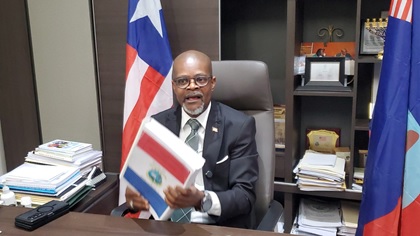
Montserrado County Senator Abraham Darius Dillon on Tuesday, December 2, 2025 pushed back against criticism that the Liberian Senate is overstepping or creating an unusual parallel process, insisting that separate Senate budget hearings are neither new nor improper and, in his view, urgently necessary.
Bility’s claims
It can be recalled that on Monday, December 1, 2025, Nimba County District 7 Musa Hassan Bility, Representative posted a communication on his official Facebook page requesting the House of Representatives to intervene in what he describes as an “unconstitutional overreach” by the Liberian Senate in its ongoing national budget hearings.
In a communication addressed to Speaker Richard Koon and members of the House, Rep. Bility stressed that the Senate’s decision to conduct budget hearings before the House has deliberated on the draft national budget violates core principles of Liberia’s legislative process.
He cited Article 34(d)(i) of the 1986 Constitution, which vests exclusive authority in the House of Representatives to originate all fiscal measures, including the National Budget.
According to Rep. Bility, the Senate’s constitutional role is limited to concurring or declining to concur with budget bills after they have been passed by the House.
“By initiating hearings on a draft budget that has not yet come before the House, the Senate assumes an originating authority not granted by the Constitution,” he argued.
Rep. Bility’s letter outlines three major concerns over the Senate’s ongoing budget activities including violation of Article 34(d)(i), Procedural Impropriety and Risk of Institutional Conflict, while contending that the Senate has acted outside its constitutional boundaries by engaging in a process reserved for the House.
The Nimba County lawmaker urged the House to formally communicate with the Senate, calling for an immediate cessation of all budget hearings until the House exercises its constitutionally mandated responsibility to originate the fiscal bill.
Describing the National Budget as “the most critical governance instrument,” Rep. Bility emphasized that strict adherence to constitutional procedure is essential to maintaining public trust and safeguarding the integrity of the legislative branch.
Dillon Counters
But speaking at a press conference in his Capitol Building office, Dillon reminded reporters that the Senate has previously held its own budget hearings, specifically in 2021 and 2022, and that he himself moved for those sessions just as he did this year.
Senator Dillon who is the Liberian Senate Committee Chairman on Foreign Affairs, indicated that the only thing that the Senate is not allowed to do is to pass the budget before the House of Representatives.
Though he did not quote or cite any constitutional provision to give validity to his counterarguments, Dillon continued: “You members of the press are in the best position to fact-check that. This has happened before.”
The senator argued that the gravity of approving a national budget exceeding $1.2 billion demands rigorous scrutiny, not rubber stamping.
“Those who sit where we sit unless their conscience does not trouble them should understand the weight of approving a $1 billion-plus national budget without opening it up,” Dillon stated.
“For too long, budgets have been passed without meaningful scrutiny, leaving the public in the dark. We do not want that.”
He emphasized that the over 700-page draft budget including allocations to major sectors such as education, security, health, and agriculture must be unpacked for lawmakers and the public alike.
Advocating for UL, Others
Dillon used the press conference to spotlight several major budget lines like University of Liberia allocation, Liberia Drug Enforcement Agency budget proposed increase from $3.9 million to over $7 million, Education sector rising from $120 million to over $134 million and Agriculture sector among others. “These are not small changes,” Dillon said. “We want the public to see this for themselves.”
While reaffirming respect for the House of Representatives which traditionally initiates the national budget, Dillon asserted that the Senate has its own constitutional responsibility to thoroughly review and, if necessary, amend the budget.
“The Senate will play the role of the elder in this matter not in age but in responsibility,” he said. “Follow their hearings and follow ours and judge the difference for yourselves.”
He emphasized that if the Senate reaches different conclusions from the House, both versions will be sent to a conference committee for harmonization something he is a standard legislative procedure.
Dillon followed with an appeal to the press, urging journalists to deepen their coverage of the national budget and its complexities.
“Too many including many in the media do not fully know what is inside this budget,” he warned. “You have an obligation to help educate the public about this.”
As the Senate continues its separate hearings, Dillon reiterated that the goal is not institutional rivalry but transparency and ensuring that the public understands how more than a billion dollars of national resources will be allocated in the year ahead.
Comments are closed.